Important Topics under NCERT Solutions for Class 6 Maths Chapter 6
Chapter 6 of the class 6 maths syllabus is on Integers. This very fundamental chapter in class 6 is divided into 4 major sections or topics. The following is a list of the important topics that are covered under NCERT Solutions for Class 6 Maths Chapter 6 – Integers. We recommend that students go through each one of these topics to make the best out of the solutions provided by Study Studio for this chapter on Integers.
- Introduction
- Integers
- Addition of Integers
- Subtraction of Integers With The Help of A Number Line
These 4 topics cover the entirety of the chapter on Integers and students can rest assured that covering these topics will enable them to practise the given solutions with ease and score great marks in their exams when faced with questions that rely on integers.
The NCERT solutions for Class 6 Maths Chapter 6 offer a concise solution to every topic of this chapter. Following this solution, alongside the textbook will help students to improve their performance, and attain better results.
NCERT Solution for Class 6 Mathematics Chapter 6 discuss the concept of integers. There are a total of four sections with subsections explaining the idea of integers in detail. You can download NCERT Solution for Class 6 Science to get more marks in examinations.
The chapter begins with a conditional problem and moves on to the introduction of negative numbers. As students’ progress through the chapter, they come across new topics like the representation of integers on a number line, ordering and addition of integers, subtraction of integers, etc.
NCERT Solutions for Class 6 Maths Chapter 6 – Integers
Refer to page 1 – 10 for Exercise 6.1 in the PDF
1. Write opposite of the following:
(a) Increase in weight
Ans: Decrease in weight will be the opposite.
(b)
3030
km north
Ans: 3030 km south will be the opposite.
(c) 326326 BC
Ans: 326326 AD will be the opposite.
(d) Loss of Rs
700700
Ans: Gain of Rs 700700 will be the opposite.
(e)
100100
m above sea level
Ans: 100100 m below sea level will be the opposite.
2. Represent the following numbers as integers with appropriate signs.
(a) An aeroplane is flying at a height two thousand meters above the ground.
Ans: +2000+2000 m will be its representation.
(b) A submarine is moving at a depth eight thousand meters below the sea level.
Ans: −8000−8000 m will be its representation.
(c) A deposit of rupees two hundred.
Ans: +200+200 Rs will be its representation.
(d) Withdrawal of rupees seven hundred.
Ans: −700−700 Rs will be its representation.
3. Represent the following numbers on number line:
(a)
+5+5
Ans: The number +5+5 on the number line will be –
(Image Will Be Updated Soon)
(b)
−10−10
Ans: The number −10−10 on the number line will be –
(Image Will Be Updated Soon)
(c)
+8+8
Ans: The number +8+8 on the number line will be –
(Image Will Be Updated Soon)
(d)
−1−1
Ans: The number −1−1 on the number line will be –
(Image Will Be Updated Soon)
(e)
−6−6
Ans: The number −6−6 on the number line will be –
(Image Will Be Updated Soon)
4. Adjacent figure is a vertical number line, representing integers. Observe it and locate the following points:
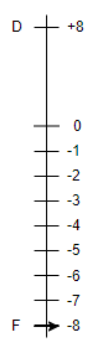
Vertical Number Line
(a) If point
D�
is
+8+8
then which point is
−8−8
?
Ans: If point D� is +8+8 then point F� will be −8−8.
Vertical Number Line from +8 to -8
(b) Is point
G�
a negative integer or a positive integer?
Ans: G� is a negative integer as it represents −6−6 on the number line.
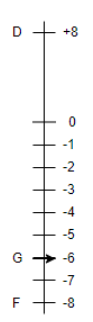
Integer G Pointing on the Number Line
(c) Write integers for points
B�
and
E�
.
Ans: Point B� represents 44 and point E� represents −10−10.
(Image Will Be Updated Soon)
(d) Which point marked on this number line has the least value?
Ans: E� has the least value as it represents −10−10.
(e) Arrange all the points in decreasing order of values.
Ans: As the highest point is
D�
and all other points lie below it. Hence,
D>C>B>A>O>H>G>F>E�>�>�>�>�>�>�>�>�
.
5. Following is the list of temperatures of five places in India, on a particular day of the year.
| Place | Temperature | |
| Siachen | 10OC10OC below 0OC0OC | _________________ |
| Shimla | 2OC2OC below 0OC0OC | _________________ |
| Ahmedabad | 30OC30OC above 0OC0OC | _________________ |
| Delhi | 20OC20OC above 0OC0OC | _________________ |
| Srinagar | 5OC5OC below 0OC0OC | _________________ |
(a) Write the temperature of these places in the form of integers in the blank column.
Ans: The temperature of these places in the form of integers will be –
Siachen
=−10∘C=−10∘�
Shimla
=−2∘C=−2∘�
Ahmedabad
=+30∘C=+30∘�
Delhi
=+20∘C=+20∘�
Srinagar
=−5∘C=−5∘�
(b) Following is the number line representing the temperature in degree Celsius.
(Image Will Be Updated Soon)
Plot the name of the city against its temperature.
Ans:
(Image Will Be Updated Soon)
As, Siachen
=−10∘C=−10∘�
Shimla
=−2∘C=−2∘�
Ahmedabad
=+30∘C=+30∘�
Delhi
=+20∘C=+20∘�
Srinagar
=−5∘C=−5∘�
(c) Which is the coolest place?
Ans: Since, the coolest place will have a very low temperature. Hence, Siachen is the coolest place.
(d) Write the names of the place where temperature is above 10OC10OC.
Ans: The places where temperature is above
10∘C10∘�
are Delhi and Ahmedabad.
6. In each of the following pairs, which number is to the right of the other on the number line?
(a) 2,92,9
Ans: As, we know that
99
is greater than
22
. Hence,
99
will be right to
22
.
(b) −3,−8−3,−8
Ans: As, we know that
−3−3
is greater than
−8−8
. Hence,
−3−3
will be right to
−8−8
.
(c) 0,−10,−1
Ans: As, we know that
00
is greater than
−1−1
. Hence,
00
will be right to
−1−1
.
(d) −11,10−11,10
Ans: As, we know that
1010
is greater than
−11−11
. Hence,
1010
will be right to
−11−11
.
(e) −6,6−6,6
Ans: As, we know that
66
is greater than
−6−6
. Hence,
66
will be right to
−6−6
.
(f) 1,−1001,−100
Ans: As, we know that
11
is greater than
−100−100
. Hence,
11
will be right to
−100−100
.
7. Write all the integers between the given pairs (write them in the increasing order):
(a) 00 and −7−7
Ans: The integers between the given pairs in the increasing order will be –
−6,−5,−4,−3,−2,−1−6,−5,−4,−3,−2,−1.
(b) −4−4 and 44
Ans: The integers between the given pairs in the increasing order will be –
−3,−2,−1,0,1,2,3−3,−2,−1,0,1,2,3.
(c) −8−8 and −15−15
Ans: The integers between the given pairs in the increasing order will be –
−14,−13,−12,−11,−10,−9−14,−13,−12,−11,−10,−9.
(d) −30−30 and −23−23
Ans: The integers between the given pairs in the increasing order will be –
−29,−28,−27,−26,−25,−24−29,−28,−27,−26,−25,−24.
8. (a) Write four negative integers greater than −20−20.
Ans: The four negative integers greater than −20−20 are –
−19,−18,−17,−16−19,−18,−17,−16.
(b) Write four negative integers less than −10−10.
Ans: The four negative integers less than −10−10 are –
−11,−12,−13,−14−11,−12,−13,−14.
9. For the following statements write True (T) or False (F). If the statement is false, correct the statement:
(a) −8−8 is to the right of −10−10 on a number line.
Ans: True. As, we know that
−8−8
is greater than
−10−10
. Hence,
−8−8
will be right to
−10−10
.
(b) −100−100 is the right of −50−50 on a number line.
Ans: False. As, we know that
−50−50
is greater than
−100−100
. Hence,
−50−50
will be right to
−100−100
.
(c) Smallest negative integer is −1−1.
Ans: False,
−1−1
is a greater integer.
(d) −26−26 is larger than −25−25.
Ans: False. As, we know that
−25−25
is greater than
−26−26
. Hence,
−25−25
will be right to
−26−26
.
10. Draw a number line and answer the following:
(a) Draw a number line, will we reach it if we move 44 numbers to the right of −2−2.
Ans: When we move
44
numbers right of
−2−2
, we will reach at
22
.
(Image Will Be Updated Soon)
(b) Which number will we reach if we move 55 numbers to the left of 11.
Ans: When we move
55
numbers left of
11
, we will reach at
−4−4
.
(Image Will Be Updated Soon)
(c) If we are at −8−8 on the number line, in which direction should we move to reach −13−13?
Ans: We will move to the left side of
−8−8
.
(d) If we are at −6−6 on the number line, in which direction should we move to reach −1−1?
Ans: We will move to the right side of
−6−6
to reach
−1−1
.
Refer to page 10 – 15 for Exercise 6.2 in the PDF
1. Using the number line write the integer which is:
(a) 33 more than 55
Ans: The number which is
33
more than
55
is:
(Image Will Be Updated Soon)
(b) 55 more than −5−5
Ans: The number which is
55
more than
−5−5
is:
(Image Will Be Updated Soon)
(c) 66 less than 22
Ans: The number which is
66
less than
22
is:
(Image Will Be Updated Soon)
(d) 33 less than −2−2
Ans: The number which is
33
less than
−2−2
is:
(Image Will Be Updated Soon)
2. Use number line and add the following integers:
(a) 9+(−6)9+(−6)
Ans: The number obtained after addition is
33
.
(Image Will Be Updated Soon)
(b) 5+(−11)5+(−11)
Ans: The number obtained after addition is
−6−6
.
(Image Will Be Updated Soon)
(c) (−1)+(−7)(−1)+(−7)
Ans: The number obtained after addition is
−8−8
.
(Image Will Be Updated Soon)
(d) (−5)+10(−5)+10
Ans: The number obtained after addition is
55
.
(Image Will Be Updated Soon)
(e) (−1)+(−2)+(−3)(−1)+(−2)+(−3)
Ans: The number obtained after addition is
−6−6
.
(Image Will Be Updated Soon)
(f) (−2)+8+(−4)(−2)+8+(−4)
Ans: The number obtained after addition is
22
.
(Image Will Be Updated Soon)
3. Add without using number line:
(a) 11+(−7)11+(−7)
Ans: After addition we have:
11−7=411−7=4.
(b) (−13)+(+18)(−13)+(+18)
Ans: After addition we have:
−13+18=5−13+18=5.
(c) (−10)+(+19)(−10)+(+19)
Ans: After addition we have:
−10+19=9−10+19=9.
(d) (−250)+(+150)(−250)+(+150)
Ans: After addition we have:
−250+150=−100−250+150=−100.
(e) (−380)+(−270)(−380)+(−270)
Ans: After addition we have:
−380−270=−650−380−270=−650.
(f) (−217)+(−100)(−217)+(−100)
Ans: After addition we have:
−217−100=−317−217−100=−317.
4. Find the sum of:
(a) 137137 and −354−354
Ans: After addition we have:
137−354=−217137−354=−217.
(b) −52−52 and 5252
Ans: After addition we have:
−52+52=0−52+52=0.
(c) −213,39−213,39 and 192192
Ans: After addition we have:
−213+39+192=18−213+39+192=18.
(d) −50,−200−50,−200 and 300300
Ans: After addition we have:
−50−200+300=−250+300−50−200+300=−250+300
⇒−250+300=50⇒−250+300=50.
5. Find the value of:
(a) (−7)+(−9)+4+16(−7)+(−9)+4+16
Ans: After addition we have:
−7−9+4+16=4−7−9+4+16=4.
(b) 37+(−2)+(−65)+(−8)37+(−2)+(−65)+(−8)
Ans: After addition we have:
37−2−65−8=−3837−2−65−8=−38.
Refer to page 15 – 18 for Exercise 6.3 in the PDF
- Subtract the following –
(a) 35−(20)35−(20)
Ans: After subtraction we have:
35−20=1535−20=15.
(b) 72−(90)72−(90)
Ans: After subtraction we have:
72−90=−1872−90=−18.
(c) (−15)−(−18)(−15)−(−18)
Ans: After subtraction we have:
−15+18=3−15+18=3.
(d) (−20)−(13)(−20)−(13)
Ans: After subtraction we have:
−20−13=−33−20−13=−33.
(e) 23−(−12)23−(−12)
Ans: After subtraction we have:
23+12=3523+12=35.
(f) (−32)−(−40)(−32)−(−40)
Ans: After subtraction we have:
−32+40=8−32+40=8.
2. Fill in the blanks with >>, << or == sign:
(a) (−3)+(−6)________(−3)−(−6)(−3)+(−6)________(−3)−(−6)
Ans: After simplifying the expression, we have:
−3−6=−9−3−6=−9 and
−3+6=3−3+6=3
Hence, 3>−93>−9.
(b) (−21)−(−10)________(−31)+(−11)(−21)−(−10)________(−31)+(−11)
Ans: After simplifying the expression, we have:
−21+10=−11−21+10=−11 and
−31−11=−42−31−11=−42
Hence, −11>−42−11>−42.
(c) 45−(−11)________57+(−4)45−(−11)________57+(−4)
Ans: After simplifying the expression, we have:
45+11=5645+11=56 and
57−4=5357−4=53
Hence, 56>5356>53.
(d) (−25)−(−42)________(−42)−(−25)(−25)−(−42)________(−42)−(−25)
Ans: After simplifying the expression, we have:
−25+42=17−25+42=17 and
−42+25=−17−42+25=−17
Hence, 17>−1717>−17.
3. Fill in the blanks:
(a) (−8)+________=0(−8)+________=0
Ans: We have −8+8=0−8+8=0.
(b) 13+________=013+________=0
Ans: We have 13−13=013−13=0.
(c) 12+(−12)=________12+(−12)=________
Ans: We have 12−12=012−12=0.
(d) (−4)+________=−12(−4)+________=−12
Ans: We have −4−8=−12−4−8=−12.
(e) ________−15=−10________−15=−10
Ans: We have 5−15=−105−15=−10.
4. Find:
(a) (−7)−8−(−25)(−7)−8−(−25)
Ans: After simplifying, we have:
−7−8+25=−15+25−7−8+25=−15+25
⇒−15+25=10⇒−15+25=10.
(b) (−13)+32−8−1(−13)+32−8−1
Ans: After simplifying, we have:
−13+32−8−1=−22+32−13+32−8−1=−22+32
⇒−22+32=10⇒−22+32=10.
(c) (−7)+(−8)+(−90)(−7)+(−8)+(−90)
Ans: After simplifying, we have:
−7−8−90=−15−90−7−8−90=−15−90
⇒−15−90=−105⇒−15−90=−105.
(d) 50−(−40)−(−2)50−(−40)−(−2)
Ans: After simplifying, we have:
50+40+2=90+250+40+2=90+2
⇒90+2=92⇒90+2=92.
NCERT Solutions for Class 6 Maths Chapter 6 – Integers
NCERT solutions for Class 6 Maths Chapter 6 are an essential study material for students who are preparing for their exam. This solution explains the concept in a more straightforward manner, and aid students to grasp a topic quickly. Hence, understanding the basics as well as advanced concepts becomes easy. These solutions are available online for free, and once can easily access them via various websites.
NCERT Class 6 Maths Solutions Topic-Wise Discussion
Class 6 Maths Chapter 6 has a total of four sections and following is a topic-wise discussion on each of them.
- Introduction
The chapter of Integers Class 6 NCERT begins with an introduction that includes some examples. It talks about a girl named Sunita who needs 10 bananas for her picnic, but her mother has only 8 of them. Hence, she borrows two from her neighbour. This example further discusses how Sunita needs to return 2 bananas to her neighbour. Few other examples like this present in this chapter introduce the concept of integers to students.
This introduction then further discusses various signs attached to numbers and what they signify.
- Integers
The second section of this chapter then moves into the discussion of Integers class 6. Students already know about the natural number; in this chapter, they move on to the concept of negative integers.
Use of various figures helps students further to grasp the concept of different numbers like the whole number, natural number, negative number, and integers easily. After that, they learn how to represent different integers with the assistance of a single line.
Ordering of integers follows next, where students learn how to arrange these integers according to their value. With the help of NCERT solutions, students can quickly learn these relatively complex concepts and get a better understanding of it.
- Addition of Integers
Students must know the concept of how to add Integer Class 6, as it is an essential concept for their exam as well as their daily life. In this chapter, they get to learn it via an interesting example. There is a boy named Mohan, and his house has steps to access both the terrace and godown. Here the steps to the terrace are considered as positive integers and the ones towards the godown are negative integers, and the ground level is zero. In this way, they can learn how to count integers by moving up and down the stairs.
Along with that, there are other examples with dice, tiles and buttons to further simplify this concept. Also, students learn how to add Integers for Class 6 by using a straight line.
- Subtraction of Integers With The Help of A Number Line
Following the addition, students learn how to subtract Class 6 Maths Integers using a single line. There are different methods to this process, which are further explained under this section.
Why NCERT Solution For Class 6 Maths Chapter 6 Integers is a Must-Read?
Using the NCERT solutions for Class 6 Maths Chapter 6 students can grasp any concept quickly. Here are some other advantages of following it –
- The language used in these solutions is lucid and helps students to comprehend any topic better.
- The simple yet detailed explanation helps individuals to get a better idea about every topic.
- The use of bullet points, graphs, charts, etc. makes the learning experience engaging.
- Moreover, the use of real-life examples helps individuals to relate to a topic better and understand it comfortably.
- Since NCERT solutions of Class 6th Math integers follow the CBSE guidelines; it helps students to prepare better for their exam.
A Final Word
NCERT solutions for Class 6 Maths Chapter 6 offers further assistance to the students to improve their preparations. Also, these books are easily accessible via online learning platforms like Study Studio. Being one of India’s top e-learning platforms, Study Studio offers study material, online classes, and special sessions to aid students further.
Chapter wise NCERT Solutions for Class 6 Maths
- Chapter 1 – Knowing Our Numbers
- Chapter 2 – Whole Numbers
- Chapter 3 – Playing with Numbers
- Chapter 4 – Basic Geometrical Ideas
- Chapter 5 – Understanding Elementary Shapes
- Chapter 6 – Integers
- Chapter 7 – Fractions
- Chapter 8 – Decimals
- Chapter 9 – Data Handling
- Chapter 10 – Mensuration
- Chapter 11 – Algebra
- Chapter 12 – Ratio and Proportion
- Chapter 13 – Symmetry
- Chapter 14 – Practical Geometry
Along with this, students can also view additional study materials provided by Vedantu, for Class 6 Maths Chapter 1 Knowing Our Numbers
NCERT Solution Class 6 Maths of Chapter 6 All Exercises
| Chapter 6 – Integers Exercises in PDF Format | |
| EXERCISE 6.1 | 10 Questions with Solutions |
| EXERCISE 6.2 | 5 Questions with Solutions |
| EXERCISE 6.3 | 4 Questions with Solutions |
Conclusion
Study Studio’s NCERT Solutions for Class 6 Maths Chapter 6 – “Integers” provide an invaluable resource for young learners. These solutions are meticulously designed to align seamlessly with the NCERT curriculum, ensuring that students receive clear explanations and step-by-step guidance in understanding the world of integers. By simplifying the often complex concepts of positive and negative numbers, these solutions empower students to develop a strong foundation in mathematics. Study Studio’s commitment to quality education shines through in these solutions, making them an essential tool for Class 6 students. By utilising these NCERT Solutions, students can enhance their mathematical skills, critical thinking abilities, and overall academic performance, building a solid base for future mathematical pursuits.
Is this page helpful?