The NCERT Science Class 7 Chapter 16 is an authentic reference source that offers students concise and simple comprehension of the chapter Water: A Precious Resource in an interesting manner.Students revising or preparing for their intermediate tests or annual examination can access the NCERT Science Book Class 7 Chapter 18 to comprehend the chapter and gain a concise understanding of all the essential concepts.
Access NCERT Solutions for Science Chapter 16 – Water: a precious resource
Important Topics
The important topics that are covered in this chapter include:
- How much water is available
- Types of water
- Groundwater as an important source of water
- Depletion of the water table
- Increasing population
- Distribution of water
- Increasing industries
- Agricultural activities
- Water management
- Water-wise habits
- What role you can play
- Effect of water scarcity on plants
Important Points
- Through the process of infiltration, the groundwater is replenished. Infiltration refers to the seepage of water from rivers and lakes into voids and fissures deep under the surface.
- The impact on the water table is determined by the amount of subsurface water replenished. The water used for daily residential needs will not alter the water table because only five families will share a tubewell. However, if there is a lack of rain, the family’s water supply will be depleted, and the water table would plummet.
- To reduce water waste, we’ll utilize drip irrigation, which directs water to the roots of plants. We’ll look for leaks in the water lines and set up little rainwater gathering pits. All this collected rainwater will be used for further uses later.
1. Mark “T” if the statement is true and ‘F” if it is false:
a) The freshwater stored in the ground is much more than that present in the rivers and lakes of the world.
Ans: True.
b) Water shortage is a problem faced only by people living in rural areas.
Ans: False.
c) Water from rivers is the only source for irrigation in the fields.
Ans: False.
d) Rain is the ultimate source of water.
Ans: True.
2. Explain how groundwater is recharged?
Ans:
The method of infiltration is used to recharge the groundwater. This refers to water seeping into empty areas and fractures beneath the earth from sources such as rivers and ponds. The procedure is known as groundwater recharge.
3. There are ten tube wells in a lane of fifty houses. What could be the long-term impact on the water table?
Ans:
More tube wells will deplete the groundwater table, but if only five families share a tube well, the water utilised for everyday domestic purposes will not have an impact on the water table. However, there may come a moment when there is no water beneath the pipe.
4. You have been asked to maintain a garden. How will you minimize the use of water?
Ans:
Sprinkler irrigation or drip irrigation can be used to maintain the garden while consuming the least amount of electricity.
Rainwater gathering is possible, and the collected water can be used in the gardening process.
5. Explain the factors responsible for the depletion of the water table.
Ans:
The following are the primary causes of water table depletion:
i) Growing population: As the population grows, so does the demand for daily services. This will result in a drop in groundwater levels.
ii) Growing industries: As the number of companies grows, more water will be required for daily consumption and tasks, affecting groundwater.
iii) Agricultural activities: Agriculture is a heavily reliant industry in our country. As a result, the amount of land used for agriculture has increased. Water use for agriculture has also increased. The usage of groundwater increases as a result of unpredictable rainfall. These are the primary causes of water table depletion.
6. Fill in the blanks with the appropriate answers:
I) People obtain groundwater through ———– and ————.
Ans: People obtain groundwater through a well and hand pumps.
II) Three forms of water are —–, ——- and ————-.
Ans: Three forms of water are ice, water and water vapour.
III) The water-bearing layer of the earth is ———.
Ans: The water-bearing layer of the earth is an aquifer.
IV) The process of water seeping into the ground is called ——–.
Ans: The process of water seepage into the ground is called infiltration.
7. Which one of the following is not responsible for water shortage?
I) The rapid growth of industries.
II) Increasing population.
III) Heavy rainfall.
IV) Mismanagement of water resources.
Ans: iii. Heavy rainfall is the one not responsible for water shortage.
8. Choose the correct option. Total water
I) In the lakes and rivers of the world remain constant.
II) Under the ground remain constant.
III) In the seas and oceans of the world remains constant.
IV) Of the world remains constant.
Ans: iv. The total water of the world remains constant.
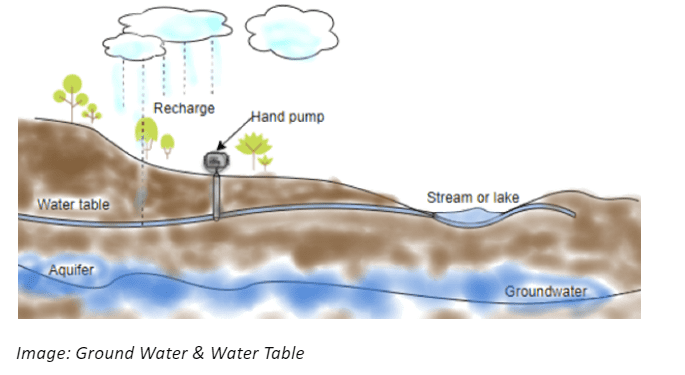
9. Make a sketch showing groundwater and water table. Label it.
Ans:
NCERT Solution of Class 7 Science Chapter 16 – Free PDF Download
NCERT Class 7 Science Chapter 16 offers authentic and credible sources of information to efficiently comprehend, analyse, and answer. The NCERT Solution for Class 7th Science Chapter 16 provides students with a comprehensive view of how to analyse and decode the chapter Water: A Precious Resource and answer questions efficiently. NCERT Solutions Class 7 Science Chapter 16 is an easy scoring chapter, including all the important concepts, definitions, and topics.
NCERT Solution Class 7 Chapter 16
NCERT Solution of Class 7 Science Chapter 16 states the importance of water and multiple benefits. Water is an important natural resource in three forms- solid form, Liquid, and Vapour form. Though there is a continuous cycle, there still exists acute water scarcity across the globe. The uneven distribution of water in the world is an outcome of the tarnished human activities.
The Chapter Water: A Precious Resource deals with issues as environmental awareness. The chapter briefs the rapid growth and mismanagement of all the factors that impact water scarcity and throws light on Groundwater’s importance and the need to conserve.
Chapter 16 Class 7 Science enlists the factors like population, the growth rate of irrigation, the rapid growth of industries, etc. that leads to water scarcity. The chapter even briefs students on Water Management on the implementation of Rain Harvesting and Drip Irrigation and every individual’s role in solving the issue. The chapter even briefs the effects of water scarcity on plants and how to solve the rising water crisis problem.
NCERT Solution Class 7 Science Chapter 16 guides students through the chapter and enlists the important measures and activities to solve the water scarcity problem faced across the globe. The chapter on Water: A Precious Resource demonstrates the significance of water in every individual’s life, whether human, animal, or plant, and also creates awareness on water scarcity and the implementation of the methods among students.
Benefits of NCERT Solutions Class 7 Science Chapter 16- Water: A Precious Resource
NCERT Class 7 Science Chapter 16 is based on the Water: A Precious Resource, its by-products, sewage, and the role of safe disposal methods. The overall weightage for NCERT Class 7 Science Chapter 16 mainly focuses on long and short answers. During tests or annual examinations, the chapter Water: A Precious Resource holds a primacy of four, six, or eight scores. Chapter 16 Class 7 Science encompasses all the vital questions from the chapter of the NCERT textbook. The crucial concepts included in the chapter are as follows:
- Ex 16 – Water: A Precious Resource
- Ex 16.1 – How much Water is Available.
- Ex 16.2 – Forms of Water
- Ex 16.3 – Groundwater as an Important Source of Water
- Ex 16.4 – Depletion of Water Table
- Ex 16.5 – Distribution of Water
- Ex 16.6 – Water Management
- Ex 16.7 – What Role You can Play
- Ex 16.8 – Effect of Water Scarcity on Plants
Benefits of NCERT Solutions Class 7 Science Chapter 16
NCERT Solutions for Class 7th Science Chapter 16 is an easy and scoring chapter that presents a comprehensive brief and rudimentary knowledge of the chapter Water: A Precious Resource to help aspirants secure better percentages. A few benefits of NCERT Class 7 Science Chapter 16 are as follows:
- Chapter 16 Science Class 7 offers in-depth knowledge of the chapter in simple and understandable words to help students comprehend the essential concepts and the chapter’s contents.
- The Science Chapter 16 Class 7 provides the latest and up-to-date course curriculum, learning provisions, and detailed revision materials to keep students problem-free for the year ahead.
- NCERT Solutions for Class 7 Science Chapter 16 comprises all important concepts that fall under Water: A Precious Resource. NCERT Solutions help students comprehend all the crucial topics from the chapters.
- Students can save enough time through Chapter 16 Class 7 Science’s reference during their test or exam as it offers authentic, simple, and detailed explanations on the chapter Water: A Precious Resource.
- The activities, mock exercises, and the list of important questions briefed at the end of Chapter 16 Science Class 7 creates a brief and detailed understanding of all the important and essential concepts highlighted in the chapter.
Conclusion
The NCERT Solutions for Class 7 Science Chapter 16 – Water: A Precious Resource, provided by Study Studio, is a valuable tool for Class 7 students. It helps introduce Science concepts in an accessible manner. The provided solutions and explanations simplify complex ideas, making it easier for Class 7 students to understand the material. By using Study Studio’s resources, Students can develop a deeper understanding of NCERT concepts. These solutions are a helpful aid for Class 7 students, empowering them to excel in their studies and develop a genuine appreciation for “Water: A Precious Resource”.