The NCERT Solutions for Class 7 Science chapter 15 provide accurate answers to all the exercise questions. With its help alongside textbooks, students can improve their exam preparations, and secure better marks.
Access NCERT Solutions for Class 7 Science Chapter 15 – Light
1. Fill in the blanks:
a. An image that cannot be obtained on a screen is called ———-.
Ans: Virtual image.
b. The image formed by a concave ———- is always virtual and smaller in size.
Ans: Mirror.
c. An image formed by a ————- mirror is always of the same size as that of the object.
Ans: Plane.
d. An image that can be obtained on a screen is called a ——— image.
Ans: Real.
e. An image formed by a concave —————- cannot be obtained on a screen.
Ans: Lens.
2. Mark “T” if the statement is true and “F’ if it is false.
a. We can obtain an enlarged and erect image by a convex mirror.
Ans: F.
The convex mirror forms an erect and diminished image.
b. A concave lens always forms a real image.
Ans: F
Concave lenses form virtual, erect and diminished images.
c. We can obtain a real, enlarged and inverted image by a concave mirror.
Ans: T
d. A real image cannot be obtained on the screen.
Ans: F
It is a virtual image that cannot be obtained on the screen.
e. A concave mirror always forms a real image.
Ans: F
Concave mirrors can also form virtual images.
3. Match the items given in Column I with one or more items in Column II.
| Column I | Column II |
| A plane mirrorA convex mirrorA convex lens A concave mirror A concave lens | used as a magnifying glass.can form images of objects Spread over a large area. used by dentists to see enlarged images of teeth. the image is always inverted and magnified. the image is erect and of the same size as the object. the image is erect and smaller in size than the object. |
Ans: The table showing the matched answers is,
| Column I | Column II |
| A plane mirror | v. the image is erect and of the same size as the object. |
| A convex mirror | ii. can form images of objects Spread over a large area. |
| A convex lens | i. used as a magnifying glass. |
| A concave mirror | iii. used by dentists to see enlarged images of teeth. |
| A concave lens | iv. the image is always inverted and magnified. |
4. State the characteristic of the image formed by a plane mirror.
Ans: Characteristics of the image formed by a plane mirror are:
- The image distance is equal to object distance.
- Image height is equal to object height.
- The image is virtual and erect.
5. Find out the letters of the English alphabet or any other language known to you in which the image formed in a plane mirror appears exactly like the letter itself. Discuss your findings.
Ans: A, H, O, T, U, V, W, X, Y are the letters in the English alphabet which form the same image as the letter is, as they are laterally symmetrical.
6. What is a virtual image? Give one situation where a virtual image is formed.
Ans: Virtual image: When light rays seem to originate at a spot but do not actually intersect, a virtual image is created. It is visible to human eyes. As a result, rear-view mirrors create virtual images.
The situations where a virtual image is formed:
- It is formed when reflected rays appear to meet.
- Such images cannot be obtained on the screen.
- Virtual images are always formed in the plane mirror and convex mirror.
7. State the differences between a convex and a concave lens.
Ans: The difference between convex and concave lens is shown below:
| Convex lens | Concave lens |
| The convex lens is thicker at the middle and thinner at the edges.They can form a real image. | The concave lens is thinner in the middle, thicker at the edges.They can not form a real image. |
8. Give one use of a concave and a convex mirror.
Ans: Use of the concave and convex mirror:
- Concave mirror – used as a reflector in a torch.
- Convex mirror – used in vehicles as a rear-view mirror.
9. Which type of lens always forms a real image?
Ans: Neither concave nor convex lens always form a real image. A convex lens forms both real and virtual images. A concave lens forms virtual, erect and diminished images.
10. Which type of lens always forms a virtual image?
Ans: The type of lens which always forms a virtual image is:
- A concave lens always forms a virtual image.
- After the rays are refracted, they never converge and so there will be no real image.
Choose the Correct Option in Questions 11-13.
11. A virtual image larger than the object can be produced by a
- Concave lens
- Concave mirror
- Convex lens
- Plane mirror
Ans: (b) Concave mirror.
A concave mirror forms a virtual image larger than the object.
12.David is observing his image in a plane mirror. The distance between the mirror and his image is 4 m. if he moves 1m towards the mirror, then the distance between David and his image will be
- 3 m
- 5 m
- 6 m
- 8 m
Ans: (c) 6 m.
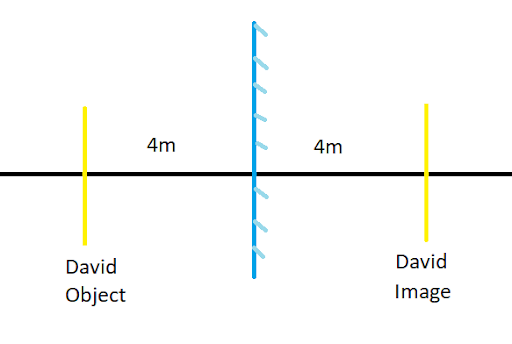
In the above image,
The distance between the mirror and the object is equal to the distance between the mirror and the image.
The distance between mirror and David image is 4m
When he moves 1m towards the mirror, then the distance is reduced as,
Distance between the mirror and the object is 4-1=3m.
Therefore, the distance between David and his image is 3+3=6m.
13. The rear-view mirror of a car is a plane mirror. A driver is reversing his car at a speed of 2 m/s. The driver sees in his rear-view mirror the image of a truck parked behind the car. The speed at which the image of the truck appears to approach the driver will be
- 1 m/s
- 2 m/s
- 4 m/s
- 8 m/s.
Ans: (c) 4 m/s.
In a plane mirror, the object and its image always remain at the same distance from the mirror. So, when the car reverses at a speed of 2m/s, then the image will also appear to move towards the driver.
Therefore, the speed at which the image of the truck appears to approach the driver will be 2+2=4m/s.
NCERT Solutions for Class 7 Science Chapter 15 – Free PDF Download
Important Topics Covered Under Class 7 Science Chapter 15 Light
Important Topics of NCERT Class 7 Science Chapter 15 are given below.
| Section | Topic Name |
| 15 | Light. |
| 15.1 | Light travels along a straight line. |
| 15.2 | Reflection of light. |
| 15.3 | Right or left! |
| 15.4 | Playing with spherical mirrors. |
| 15.5 | Images formed by lenses. |
| 15.6 | Sunlight — white or coloured? |
Important Points to Remember
Before starting with the NCERT Solutions for Class 7 Science Chapter 15, here are a few important points that you should remember about the chapter.
- Light is a form of energy that enables us to see objects when it gets reflected from them. Light can be detected through our eyes.
- Light travels along a straight line.
- There are two types of images i.e real images and virtual images.
- The process of changing the path of light through a mirror or shiny object is called the reflection of light.
- There are two types of spherical mirrors i.e. convex mirrors and concave mirrors.
- Lenses are defined as transparent pieces of glass. Lenses are bounded by two spherical surfaces.
- When white light passes through a glass prism then white light gets split into seven colors. This phenomenon of splitting white light is called dispersion of light.
NCERT solutions for class 7 Science chapter 15 discuss the problems associated with the concept of light. In this chapter, students will learn about various principles of light, its reflection, and others.
This chapter has six topics, and each one describes a key principle of light. It begins with an introduction to the definition of light, then moves on to the concept of how light travels through a straight line. It further explains how the reflection of light works and the way lenses form images.
The solution of NCERT Science book class 7 chapter 15 is one essential study material for students of class seven. It directly explains these concepts and helps students to understand the principles quickly.
NCERT Class 7 Science Chapter 15 Light PDF Topic-Wise Discussion
Chapter 15 Science class 7 of NCERT solutions has seven sub-sections. Here is a detailed discussion on each topic.
Introduction
NCERT Class 7 Science chapter 15 Light begins with an introduction to the topic and explains how everyone has noticed some properties of light in their daily life. This offers a brief outline of the chapter and shows the properties of light that students will learn in this chapter.
Light Travels Along a Straight Line
In the following section, students will learn about one of the most important characteristics of light, i.e., it always travels in a straight line, irrespective of its source. This section further encourages students to perform a simple experiment. They can use a straight pipe and a bent one to view a candlelight, and experience the difference.
Reflection of Light
As students have already studied how mirrors can change the direction of light, it is also regarded as a reflection of light. Various activities scattered throughout this section of NCERT solutions for class 7 Science chapter 15 can aid students to get a better understanding of this concept. One of them is to place a lighted candle in front of a mirror. Now, move it around to understand various reflections of light.
Right or Left
In this section of CBSE class 7 Science chapter 15 students will learn about lateral inversion. It means the phenomenon of a left-handed person appearing as right-handed in front of a mirror and vice versa. This is the reason behind the word Ambulance written in the right to left manner. Due to this, drivers of other vehicles can read it in their rear-view mirrors.
Playing with Spherical Mirror
This topic of class 7th Science chapter 15 helps students to understand the concept of a virtual and a real image. Also, students can perform easy experiments to see the characteristics of a spherical mirror. They can use a spoon and see their reflection in it, and find out that the image looks erect. Here the inner surface of a spoon acts as a concave mirror, and the outer surface is like a convex mirror.
Image Formed by Lenses
This section of ch 15 Science class 7 focuses on different types of lenses. It explains the properties of various lenses and their usage. Also, it encourages students to perform various home-made experiments to find out the effects of multiple lenses.
Sunlight – White or Coloured
The last part of Light class 7 discusses whether sunlight has color or not. The activities of this section encourage students to look at rainbow and soap bubbles to see how they portray seven colors. In this section, students will get to know more about white sunlight and its different colors.
Reasons to Opt for NCERT Solutions for Class 7 Science Chapter 15
Here are some prominent reasons to choose NCERT solutions for class 7 Science chapter Light to prepare for class seven science exam :
- These solutions are prepared according to the guideline of CBSE. Hence, students can prepare better as per their syllabus.
- The use of simple language and detailed explanation of every topic helps students to comprehend the topics easily.
- Also, the use of real-life examples helps students to associate with various concepts without any difficulties.
- The use of graphs, charts, and pictures make the learning experience engaging and helps students to understand a topic better.
- The answers are prepared in a way that will help them to secure better marks in the final exam.
Conclusion
The NCERT Solutions Class 7 Science Chapter 15 – Light, provided by Study Studio, is a valuable tool for Class 7 students. It helps introduce Science concepts in an accessible manner. The provided solutions and explanations simplify complex ideas, making it easier for Class 7 students to understand the material. By using Study Studio’s resources, Students can develop a deeper understanding of NCERT concepts. These solutions are a helpful aid for Class 7 students, empowering them to excel in their studies and develop a genuine appreciation for “Light”.
NCERT solutions for class 7 Science chapter 15 are available for free online for students to download and start preparing. With its precise and accurate answers, students can refer to these study resources to improve their marks. In case of any other difficulties, students can take the assistance of Study Studio – one of India’s leading e-learning platforms. These NCERT solutions are available on the website and mobile application of Study Studio for free.