NCERT Solutions for Class 3 EVS Chapter 6 – Foods we Eat, designed by experienced teachers and subject experts at Study Studio as per the latest syllabus of NCERT (CBSE). On Study Studio’s platform you will find all the solutions for the exercise questions covered in the Class 3 EVS Chapter 6. Notes for this chapter are also available, which will help you to revise the complete topic thoroughly and score good marks in your exams. Study Studio has very well structured study materials and reference notes with lots of worksheets and mock tests. These tests and worksheets will help you to improve your scores in the exams.
You can practice and verify your answers with NCERT Solutions for Class 3 EVS Chapter 6 – Foods We Eat offered by Study Studio. You can choose the topic you think you are weak in and prepare it thoroughly for your exams at a pace that suits you. You can also take the help of our qualified and experienced teachers if you want to clear any doubt relating to the topic. NCERT Solutions Pdf are also available on this page below, which students can download and refer according to their convenience.
Access NCERT Solutions for Science class 3 Chapter 6 – Foods We Eat
1. What did you eat yesterday? Write it on the plate.

Ans: Yesterday, I ate paneer, mixed dal, rice, roti, potato fry and a gulab jamun.
2. Did all the children in the class eat the same food items yesterday? Why?
Ans: No, not all of the students in the class ate the same foods yesterday. Because various food items were prepared in each household.
3. You must have noticed that in the picture (Page 36) there is one child in whose house no food was cooked. What could be the reason?
Ans: Yes, there is one child in the photograph whose family does not cook. I believe the cause is that her family is unable to obtain food due to their poverty.
4. Has it ever happened to you that on some day you were very hungry but there was nothing to eat? If yes, why?
Ans: Yes, there was a day when my school’s canteen was closed, and I had forgotten to pack my lunch box. I didn’t feel hungry at lunch because I ate a big breakfast. During lunch, all of my friends ate their fill. As a result, I was starving. I was starving, so I went to my class teacher and explained what had happened. She was kind enough to feed me.
5. How do you know that you are hungry?
Ans: My stomach was utterly empty. As a result, I’ve discovered that I’m hungry.
6. How do you feel when you are hungry?
Ans: I want to eat as quickly as possible when I’m hungry. All of my favorite foods come to mind.
7. Why was Dadi not able to climb the stairs quickly?
Ans: Dadi is elderly, frail, and suffering from knee discomfort, which explains why she was unable to climb the stairs swiftly.
8. How does Dadi like to have her dal?
Ans: Dadi prefers her dal with a pinch of sugar.
9. How many people in the story can eat bhutta easily and why?
Ans: Because their teeth are powerful enough to chew maize kernels, the three people in the story can effortlessly devour the bhutta.
10. Can all old people eat bhutta? Why?
Ans: No, most elderly persons are unable to consume bhutta due to the deterioration of their teeth as they grow older.
11. For four months Chhutki will have only her mother’s milk. That is her only food. Why?
Ans: Chhutki will only drink her mother’s milk for the next four months because she is toothless and mother’s milk is a nutritious diet that is important for the baby’s growth and development.
12. Ask your elders and fill in the table.
Ans:
| Person | What can they eat | What can’t they eat |
| Child | Baby food supplements, Boiled & mashed vegetables and milk | Fritters, Salads, Nuts |
| Adolescent | Rice, Roti, Dal, Eggs, Meat, Fish, Vegetables (raw & cooked), Fruits and nuts | —– |
| Old | Curd rice, Less spicy curries, boiled & mashed grains | Biryani, High protein foods like meat & seafoods and deep-fried items |
13. Put‘✔’ on the things that you eat often.
Rice , Wheat, Barley, Oats, Maize, Millet, Kappa(tapioca), Ragi
Ans:
| Ragi ‘✔’ | Barley | Rice ‘✔’ | Ragi |
| Millet | wheat ‘✔’ | Kappa(tapioca) | Maize |
14. Find out where each of these things is eaten more.
Ans:
- Wheat – Madhya Pradesh, Chhattisgarh
- Rice – Karnataka, Tamil Nadu, West Bengal
- Ragi – Maharashtra, Orissa, Karnataka
- Millet – Bhatinda, Rajasthan
- Maize – Uttar Pradesh, Punjab
- Barley – Rajasthan, Haryana
- Oats – Punjab, Haryana
- Kappa – Assam, Kerala, Andhra Pradesh
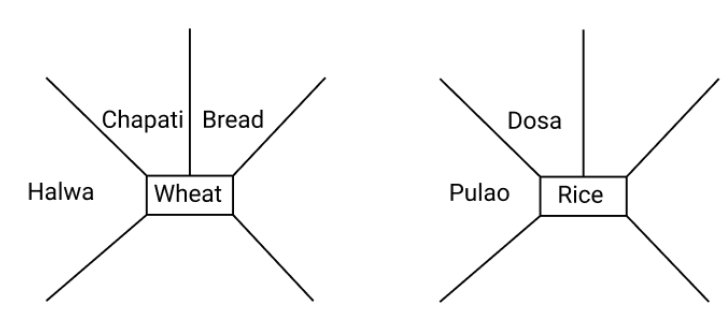
15. We not only eat different things, but we also use the same things to prepare a variety of food items. Find out and write what all can be prepared from rice and wheat.
Ans:
Wheat – Roti, Dumplings, Paratha, Burfi, Halwa, Poori, Pancake, Brown bread
Rice – Rice cake, Idiyappam, Biryani, Khichdi, Pulao, Kheer, Lemon rice, Jeera rice, Idli, Dosa, Mint rice, Fried rice
16. Write the names of three food items you like to eat and three that you dislike.
Like _________ _________ _________
Dislike _________ _________ _________
Ans:
Like – Mushrooms curry, Paneer curry, Biryani, Poori, Wada, Chicken fry
Dislike – Pumpkin curry, Upma, Cabbage curry
17. Are your likes and dislikes similar to that of
a. your family members?
b. your friends?
Ans:
- Most of my likes and dislikes are similar to my family members as we all share common food and food interests daily.
- Few of my likes and most of my dislikes are similar to my friends as their tastes are different from mine.
18. What are the reasons that decide what we eat? Put a ‘✔’ on them. Add to the list.
a. What is easily available.
b. What we can buy.
c. Customs and traditions.
______________
______________
Ans:
The following are some of the factors that influence what we eat:
✔ What is readily available?
✔ What are we able to purchase?
✔ Traditions and customs of eating practice.
✔ The things that keep us healthy.
✔ Easy to cook.
✔ Foods rich in high amounts of nutrients.
✔ Which vegetables are available in their fresh form?
19. Names of some things are given below. Put a ‘✔’ on the things that can be eaten. If there is anything about which you are not sure ask your teacher.
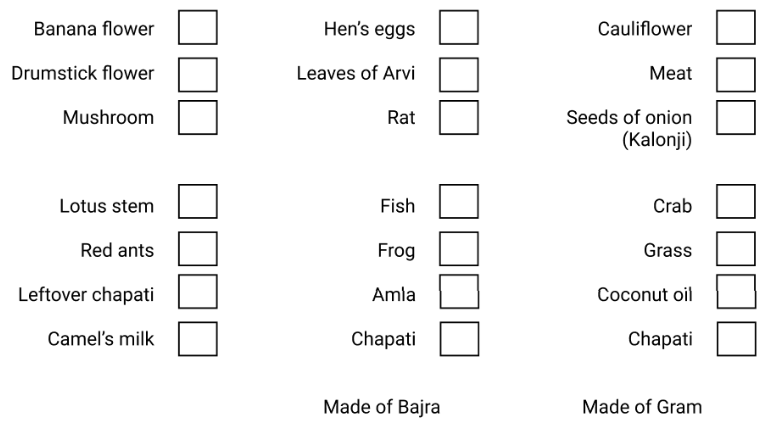
Ans:
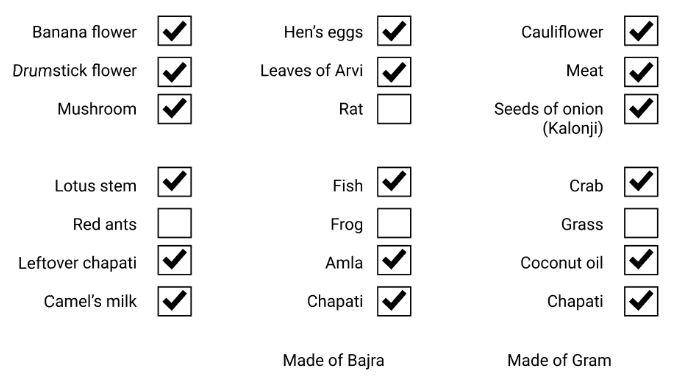
20. Write the names of some food items that you have never eaten before but feel like eating.
___________ ___________ ___________
___________ ___________ ___________
Ans: Casserole, Corn dogs and Veg lasagne are some food items that I have never eaten before but feel like eating.
Glimpses of Class 3 EVS Chapter 6 – Foods We Eat
Class 3 EVS Chapter 6 – Foods We Eat teaches us about the different kinds of food that we can eat. There are some foods that we love, like or dislike. Food also differs from culture to culture and from region to region. People eat as per the climatic conditions, culture and tradition.
Do you know the staple food of our country? It is Rice. Rice is a universal food. It is eaten by almost all across the world because rice nourishes us.
In Chapter 6 EVS for Class 3, children are discussing the food they ate and what they like or dislike. One child says that he ate chapati made out of bajra with jaggery. Another child says that she ate rice with dal. One child says that he went to gurudwara to eat langar. He ate dal and chapati in langar. One girl said she ate lots of fish that her mother cooked. It was very tasty. One child says that she did not like the kheer with poori that her mother cooked. Instead she ate an omelet. One child’s mother brought noodles for them.
So we see the different kinds of food that we eat every day. Food gives us energy to work, play and live. Food contains different useful substances called nutrients, which are needed by our body for various purposes. Food habits vary from region to region. The geography of a region influences the food that people eat. The staple or the main food of people whatever grows in the region.
Food Famous in Different Parts of India
In northern India, wheat grows in abundance and so wheat is the main food. Wheat can be made into chapattis, pooris, and parathas. In the east and south part of our country, rice is the staple food. In south India, people make dosas and idlis out of rice. In many parts of India, where there is less rainfall, people eat millet. Their small grains are ground into flour and used to make chapattis of different kinds. Dal is eaten in almost the entire country and prepared in many different styles. In the northeastern part of the country people eat bamboo shoots. People in West Bengal and Kerala are mostly non-vegetarian. That means they eat fish, chicken. People from Rajasthan and Gujarat are mostly vegetarians. That means they don’t eat non-vegetarian food. Some people are very fond of desserts like halwa, gulab jamoon, rasgulla, etc. Some people even if they like eating, they cannot eat certain food because of health issues.
In the second section of Chapter 6 EVS NCERT solutions Class 3, we are discussing some kinds of foods that are eaten in other parts of the world. Let us check what people eat in other parts of the world.
Lichen says that she lives in Hong Kong. She and her family love to eat snakes. People in China eat insects and frogs. People from Italy eat pasta and different kinds of cheeses. People from Europe, America eat more bread with pork, lamb and beef. So we see how food habits vary from region to region.
Importances of NCERT Solutions for Class 3 EVS Chapter 6 – Foods We Eat
NCERT Solutions for Class 3 EVS Chapter 6 – “Foods We Eat” hold significant importance in shaping children’s understanding of nutrition and healthy eating habits. These solutions provide a comprehensive insight into the various types of foods, their sources, and their importance for growth and well-being. By elucidating the differences between staple foods, seasonal foods, and special occasion foods, these solutions help students develop an awareness of dietary diversity. Furthermore, the emphasis on the significance of a balanced diet promotes the idea of making informed food choices. Through interactive activities and relatable examples, students are encouraged to develop a positive relationship with food and comprehend the value of nutrition for a healthy lifestyle. Overall, these solutions play a pivotal role in cultivating lifelong habits of mindful eating and fostering a foundation for overall well-being.
Conclusion
We have learnt that climatic conditions and culture of a place influence the food people eat. One thing is very important is that whatever we eat, we should eat a healthy and balanced diet. Healthy and good food keeps us fit. Junk food is indeed junk. They don’t have any nutrition value. Junk food contains high amounts of sugar and fat, and low amounts of nutrients and fibers. Junk food might cause health issues. So we should avoid having bad food as much as possible.