Environmental Science is a discipline that emphasises the significance of the environment while also instilling moral ideals in humans. Water O’ Water is quickly discussed in NCERT Answers Class 3 EVS Chapter 3. EVS Class 3 Chapter 3 NCERT Answers is an excellent technique to educate the chapter’s fundamentals while also instilling an appreciation of our natural resources. NCERT Answers Class 3 EVS Chapter 3 is everything a student needs to feel confident about comprehending the chapter. Students may investigate the idea further by using NCERT Answers for Class 3rd EVS Chapter 3 from Study Studio.
Access NCERT Solutions for EVS Class 3 Chapter 3 – Water O’ Water
Questions and Answers:
1. Do you know any poem or song on water? Recite them in the class.
Ans: A poem/song on water is given below:
Water is simple,
Water is free,
Water can help the lives,
The lives of you and me.
2. Which are the places mentioned in the poem where we find water?
Ans: The places mentioned in the poem where we can find water are: rivers, waterfalls, springs, lakes etc.
3. Tick the activities for which water is needed
To play, to sing, to row a boat, to write, to make tea, to knead dough, to run a fan, to paint pictures, to grow plants
Ans: The activities for which water is needed are:
- To make tea
- To row a boat
- To paint pictures
- To grow plants
4. Name any four activities which you can do without water and which you cannot do without water.
Ans: The activities that can be done without water are: playing cricket, sleeping, studying and dancing.
The activities that cannot be done without water are: cooking, bathing, washing cars and washing utensils.
5. Arrange the following on the basis of the amount of water that is needed for each of the activities. Begin with the activity that needs the most water.
Activities: to bathe, to drink, to clean the house, to water the fields, to knead the dough.
Ans: The activities given above can be arranged according to the quantity of the water used are:
To water the fields > to clean the house > to bath > to drink > to knead the dough
Watering the fields we require a lot of water and to knead the dough we require very less water.
6. In the poem you read about rivers, waterfalls, lakes and springs. We get water from all these places. From where do you get water? Underline those places that are either in your house or around it.
Lake, well, tube well, pond, waterfall, hand pump, river, stream, tap, tank, sea, hot water spring
Ans: The places near the houses can be as followed:
Lake, well, tube well, pond, waterfall, hand pump, river, stream, tap, tank, sea, hot water spring
7. Does any river flow through your village or city? If yes, write its name.
Ans: Yes, a river flows through my city and it is named as river Narmada.
8. Do you know the names of any rivers? Write their names.
Ans: Yes, there are many rivers whose names are known to me. Some of them are: Ganga, Yamuna, Godaveri, Krishna, Kaveri, Narmada, etc.
9. At home, where do you get drinking water from?
Ans: The drinking water at our houses comes from the municipality water department. This water is stored in pots, bottles and water coolers for drinking and cleaning purposes.
10. Do you have to go far to get water? How much time does it take to bring the water?
Ans: No, we do not have to go far away from our houses to get water. The water comes to our houses through taps in the kitchen and bathrooms.
11. Do your neighbours bring water from the same place?
Ans: Our neighbours also get their drinking water from the taps in their houses.
12. Why do we need to store water?
Ans: There are some days when the municipality has some water issues or there is a strike. So, we need to store water if there is some municipality related issue. Also, the tap does not always provide drinking water, in order to have access to the drinking water we always need to store water in pots, bottles and utensils.
13. Who fetches and stores water in your house?
Ans: The water in our house is stored and fetched by my parents and elders. Sometimes I also help them in fetching the water.
14. Are there certain people who are not allowed to take water from there?
Ans: At our house, all of my family members have access to water from the tap water. When the tap at my neighbor’s house broke, they were without water. My parents provided them with water from our tap. As a result, there are no restrictions on who can use the water. If somebody needs water, my father is always willing to assist.
15. Colour the pictures of those containers which you use for storing water.
Ans: The coloured picture of the pot used to store water in my house is:
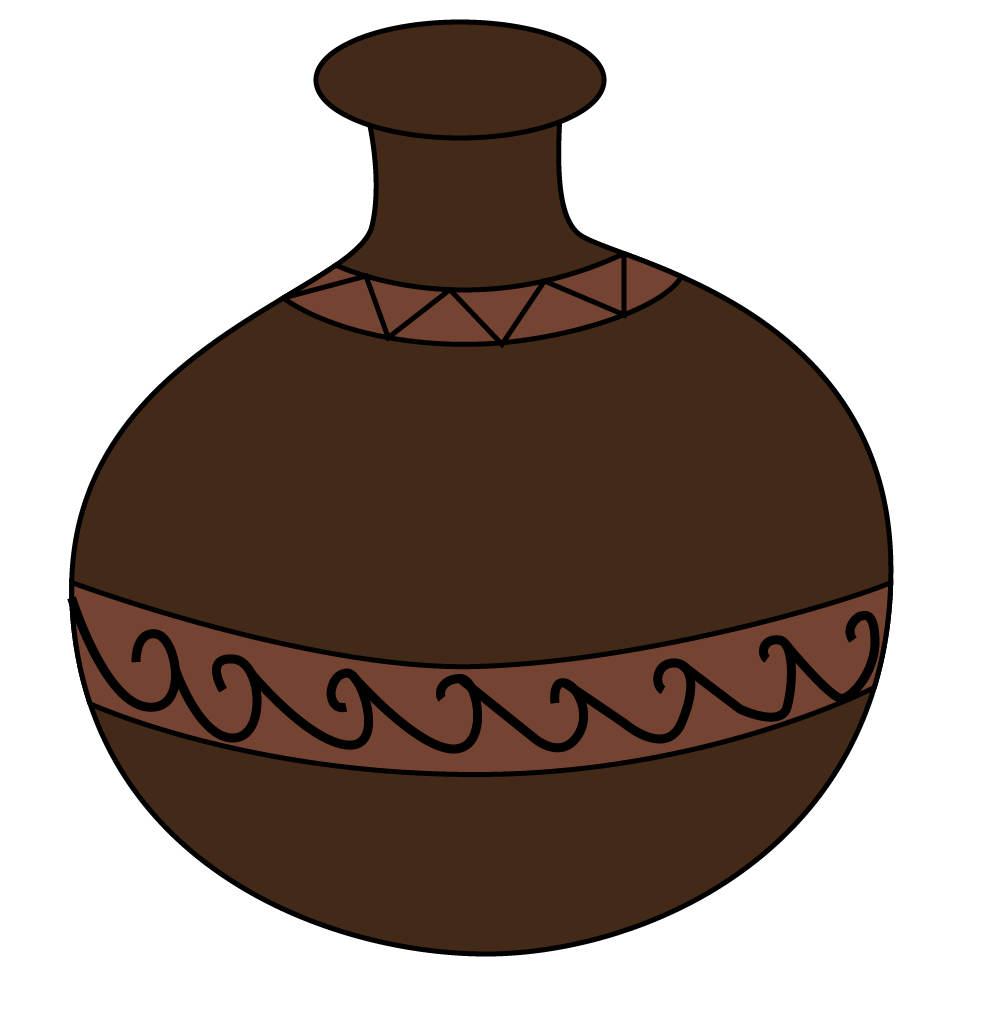
A Pot
16. In your notebook draw pictures of any other containers which are used for storing water in your house. Write their names as well.
Ans: A water tank is used to store water in my house. The picture of a water tank is:
Drawing of Water Tank
17. Take a look at the pictures. If we fill them with water –
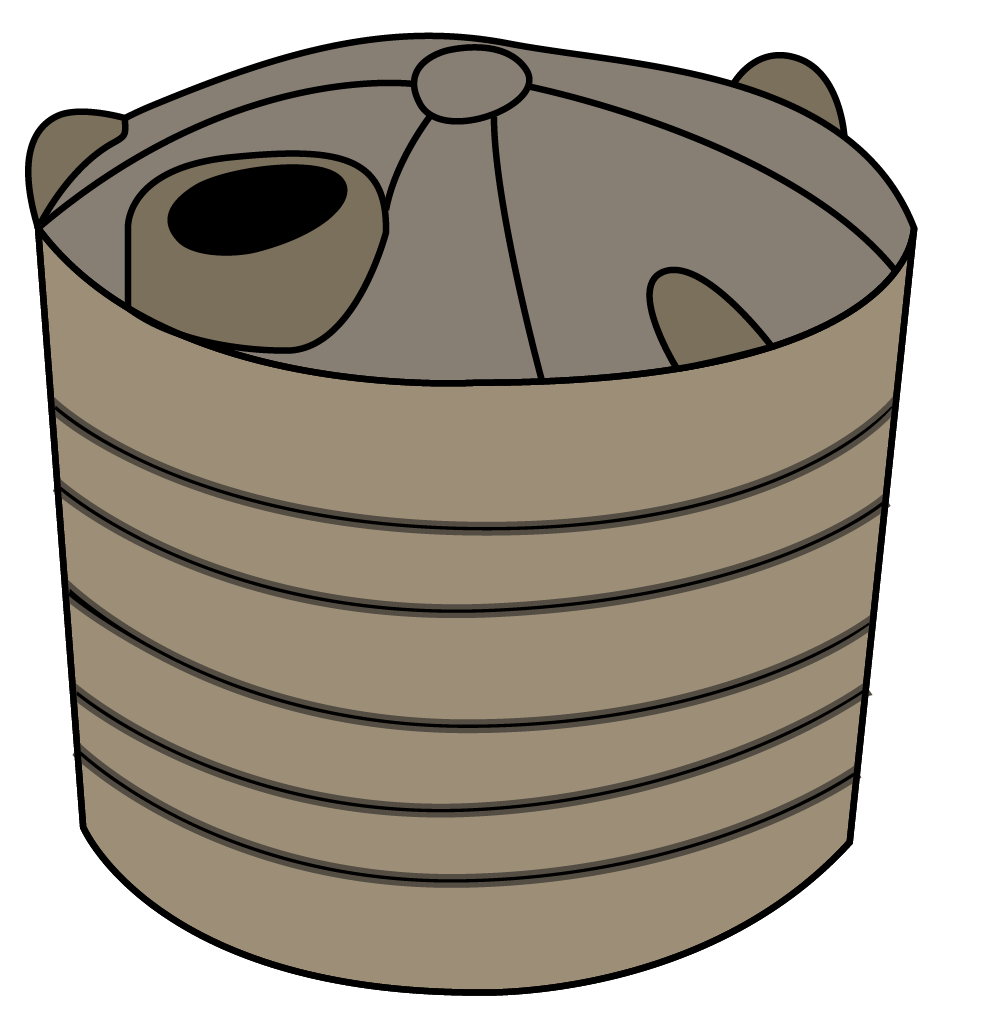
Big Water Tank (image will be uploaded soon)Small Water Tank
(i). Which will contain the least water?
Ans. The pot is small in size, so it will contain the least amount of water.
(ii). Which will contain the most water?
Ans: The size of the tank is more than the pot so, it will contain a large quantity of water.
18. What do you feel? Did Chhutki’s glass tumbler have less panna?
Ans: No, the panna in Chhutki’s glass tumbler was the same as the panna in Hiren’s tumbler. The quantity of panna in both the tumblers is the same.
19. Given in the grid are some places where water is found. Find seven of them and put a circle around each. One has already been done for you.
| w | a | t | e | r | f | a | l | l |
| e | l | a | k | e | r | p | x | q |
| l | s | e | a | s | a | o | m | t |
| l | w | i | q | y | i | n | n | a |
| x | w | e | l | l | n | d | y | p |
Ans: The seven places where water is found are marked below:
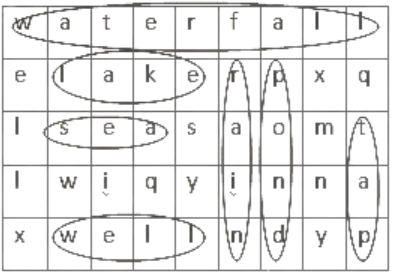
Table of places of water found
The seven places are: Waterfall, lake, rain, pond, tap and well.
20. In every row underline the one that is different from the others. Also tell how it is different.
River, mountain, lake, pond, spring
Bathing, washing clothes, swimming, combing hair, kneading dough
Fish, duck, monkey, crocodile, tortoise
Car, boat, bus, train, bicycle
Ans: The odd one out is:
River, mountain, lake, pond, spring
→ In the Above Row: river, lake, pond and spring are water bodies and mountains are not a water body.
Bathing, washing clothes, swimming, combing hair, kneading dough
→ In the Above Row: combing the hair does not require water the rest of the activities require water.
Fish, duck, monkey, crocodile, tortoise
→ In the Above Row: Fish, Duck, Crocodile and Tortoise they all live in water only Monkeys do not live in water, they live on land.
Car, boat, bus, train, bicycle
→ In the Above List: car, bus, train and bicycle they all move on land but boats move on water.
NCERT Solutions for Class 3 EVS Chapter 3 Water O’ Water
NCERT Solutions Class 3 EVS Chapter 3 – Free PDF Download
NCERT Solutions for Class 3 EVS Chapter 3 Water O’ Water can be downloaded as a PDF from Vedantu’s website and app. It is an easy and hassle-free process. The methodical approach to strengthening the foundation of the chapter guarantees the success of any student of any calibre. This NCERT Solutions Class 3 EVS Chapter 3 provides answers to main concepts, current affairs and a student’s perspective on preserving our natural resources. This has been curated by our subject experts. A student can breeze through their studies with the help of NCERT Solutions. Chapter 3 Water O’ Water Class 3 NCERT Solutions are provided in a concise manner and provide valuable guidance on the topic.
NCERT Solutions For Class 3 EVS
Chapter 3 – Water O’ Water
NCERT Environmental Science Class 3 Chapter 3 – Water O’ Water is specifically prescribed by the CBSE board and is found in NCERT EVS Class 3 textbook. It is the primary source of this concept. The chapter provides a fundamental view of the various sources of water and its types. It also highlights the importance of preserving these sources and protecting our natural resources with modern conservation techniques. Students are directed into a global perspective of the requirement of preserving the culture of the world. The chapter emphasizes this concept by providing interactive activities, visual cues and simplified terminology. These are written in a simple step-by-step format to establish a strong foundation of the topic. Our subject experts have prepared these NCERT Solutions to provide an overall knowledge base for the chapter.
NCERT Solutions Class 3 EVS Chapter Wise Marks Weightage
This Class 3rd EVS Chapter 3 has a weightage of 15 marks. This chapter is important from an exam point-of-view. Basic questions on the importance of conservation of water keep repeating in exams from this subject, for which preparing from these study materials makes students score better.
Here is More Detail About the Contents of Chapter 3 Water O Water Class 3
| 1. What is Water? (1 short )2. Sources of Water (2 MCQ’s, 1 short)3. Applications of Water in our daily lives ( 1 long)4. About Water Pollution (1 short)5. Different techniques to conserve and preserve Water (1 long) |
Why are NCERT Solutions for Class 3 EVS Chapter 3 Important?
- NCERT Solutions for Class 3 EVS Chapter 3 Water O’ Water are prepared and correlated by a team of subject matter experts who make learning memorable.
- The solutions are provided topic-wise along with brief descriptions, simplified illustrations and detailed discussions.
- Our simplified answers provide an easy understanding and a valuable learning experience for smooth exam preparation and revision.
- NCERT Environmental Science Class 3 Chapter 3 comes with important points and engaging activities to learn the concept visually and practically.
- For better understanding, the material provides a systematic overview of the chapter.
- The explanation and passion exhibited by students to preserve our natural resources are highly valued in NCERT Solutions EVS Class 3 Chapter 3.
Conclusion
Vedantu’s NCERT Solutions for Class 3 EVS Chapter 3 – Water O’ Water provide a comprehensive and engaging platform for young learners to understand the significance of water in our lives. The well-structured solutions cater to the evolving needs of students, fostering a deeper connection with nature and the environment. With clear explanations and practical examples, Vedantu empowers children to grasp the concept of water conservation and its sustainable usage. The interactive approach enhances their curiosity and encourages active participation in learning. Through Vedantu’s NCERT Solutions, Class 3 students are instilled with a sense of responsibility towards water resources, paving the way for a greener and more conscious generation ahead.