Class 7 Science Ch 14 introduces the most important topics in Science that is Electric Current and its Effects. So apart from textbooks and notes, it will be highly recommended for students to refer to Chapter 14 NCERT Solution for Class 7th Science.
Important Topics Covered in the NCERT Solutions Class 7 Science Chapter 14
The following are the important topics that are discussed in NCERT Class 7 Science Chapter 14, “Electric Current and its Effects”.
- Electric current and its effects
- Symbols of electric components
- Heating effect of electric current
- Magnetic effect of electric current
- Electromagnet
- Electric bell
NCERT Solutions for Class 7 Science Chapter 14 Electric Current and It’s Effects
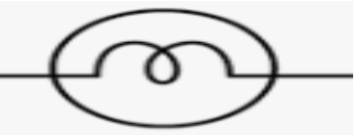
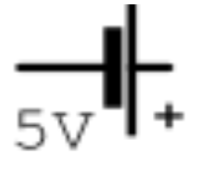
1) Draw in your notebook the symbols to represent the following components of electrical circuits. Connecting wires, switch in the OFF position, bulb, cell, switch in ON position, and battery.
Ans: The symbols for the following component of electric circuits are:
Connecting wire:

Switch in the Off position:

Bulb:
Cell:
Switch in ON position:

Battery:

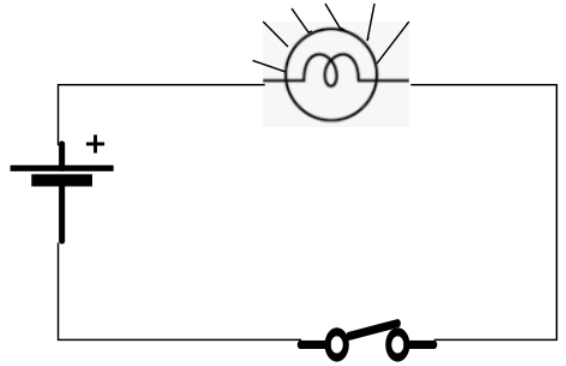
2) Draw the circuit diagram to represent the circuit shown in Fig. 14.3
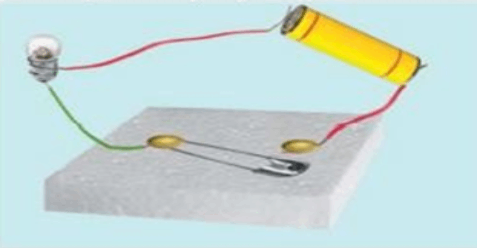
Ans: The circuit diagram for the above representation can be drawn by connecting a bulb, cell, and switch in on mode. Hence, the circuit diagram will be;
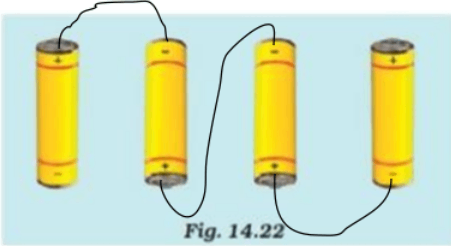
3. Fig. 14.4. Shows four cells fixed on a board. Draw lines to indicate how you will connect their terminals with wires to make a battery of four cells.
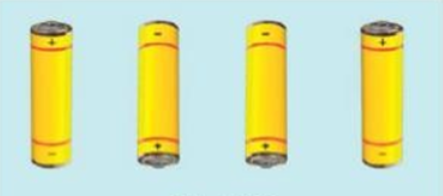
Ans: The cells are connected to each other to make a battery. In, a battery the negative end of a cell is connected to the positive end of the other cell. Hence, the cells are connected by opposite ends to make a battery.
4. The bulb in the circuit shown in Fig. 14.5 does not glow. Can you indicate the problem? Make necessary changes in the circuit to make the bulb glow.
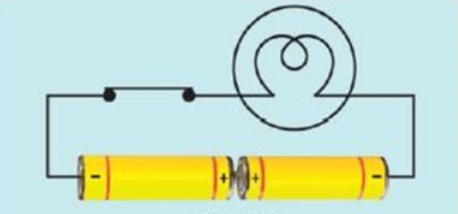
Ans: The bulb is not glowing because the cell is not Connecting systematically, the cells of a battery should be connected by opposite ends. So, the correct connection of the circuit will be:
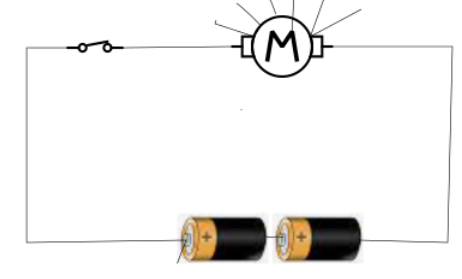
Hence, the bulb will grow after connecting the negative terminal of a cell to the positive terminal of another cell.
5. Name any two effects of electric current.
Ans: When an electric current is passed through any device or wire, then it shows heating and magnetic effect through the wire.
Hence, the two effects of electric current are the heating effect and magnetic effect.
6. When the current is switched on through a wire, a compass needle kept nearby gets deflected from its north-south position. Explain.
Ans: When the current is passed through a wire then the wire behaves like a tiny magnet. This is called the magnetic effect of current. So, when we keep a compass needle near that current flowing wire, it gets deflected from its north-south position due to the magnetic field produced by the wire.
7. Will the compass needle show the deflection when the switch in the circuit shown by Fig. 14.24 is closed?
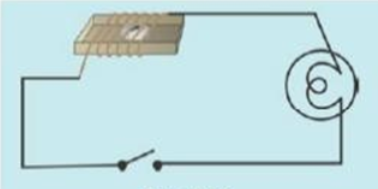
Ans: When the switch of the circuit is in a closed position then the circuit is not complete and no flow of current will take place in this case. No flow of current means no magnetic field produced. The compass needle shows deflection only in the presence of a magnetic field. Hence, the compass needle did not show deflection when the switch was off.
8. Fill in the blanks
a) Longer line in the symbol represents the __________terminal.
Ans: Longer line in the symbol represents the positive terminal.
b) The combination of two or more cells is called _______.
Ans: The combination of two or more cells is called battery.
c) When a current is switched ON in a room heater, it _________.
Ans: When a current is switched ON in a room heater, it produces heat.
d) The safety device based on the heating effect of electric current is called _______.
Ans: The safety device based on the heating effect of electric current is called a fuse.
9. Mark ‘T” if the statement is true and ‘F’ if it is false:
a) To make a battery of two cells, the negative terminal of one cell is connected to the negative terminal of the other cell.
Ans: F
b) When the current through the fuse exceeds a certain limit, the fuse wire melts and breaks.
Ans: T
c) An electromagnet does not attract a piece of iron.
Ans: F
d) An electric bell has an electromagnet.
Ans: T
10. Do you think an electromagnet can be used for separating plastic bags from a garbage heap? Explain.
Ans: An electromagnet can be made by flowing electricity through the conductor or wire. It only attracts electromagnetic materials like iron. It does not attract plastic or plastic bags. So, it cannot be used to separate plastic bags from the garbage as it is not attracted by an electromagnet.
11. An electrician is carrying out some repairs in your house. He wants to replace a fuse with a piece of wire. Would you agree? Give reasons for your response.
Ans: The fuse is made of a very low melting point wire So when the amount of electricity exceeds a limited amount of electricity. Then it melts and breaks, So our home is safe from short circuits. But the melting point of the metallic wire is high and it won’t melt and break when the amount of electricity exceeds. So, we did not allow him to replace the fuse with a wire.
12. Zubeda made an electric circuit using a cell holder shown in Fig. 14.4, a switch and a bulb. When she put the switch in the ON position, the bulb did not glow. Help Zubeda in identifying the possible defects in the circuit.
Ans: There can be several defects in a circuit due to which the bulb does not glow. Some of the common defects may be;
i) The connection of the wire to the cell and bulb may be loose.
ii) The cell used in the circuit may be used up.
iii) The switch is defective.
iv) The bulb is fused.
13. In the circuit shown in Fig. 14.25.
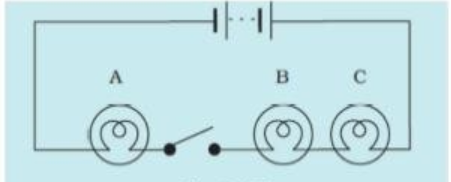
i) Would any of the bulbs glow when the switch is in the ‘OF’ position?
Ans: When the switch is off then the circuit will be incomplete and no current will flow through the circuit. So, the bulb will not glow.
ii) What will be the order in which bulbs A, B, C will glow when the switch is moved to the ‘ON’ position?
Ans: When the switch is on then the current flows through the circuit very quickly and all three bulbs will glow at the same time.
NCERT Solutions Class 7 Science Chapter 14: Key Points at a Glance
The following are some of the important points discussed in the Class 7 chapter of Electric Current and its Effects.
- While retained under the effect of an electromagnetic field, electric charge is defined as one of the matter’s basic physical properties that permits it to experience a unique form of force.
- Positive and negative charges are the two different kinds of charges.
- Conductors are substances or materials that provide comparatively reduced resistance to the electric current passing through them.
- Insulators are materials that provide greater resistance to the electric current passing through them.
- When electricity flows through a current-carrying wire, it becomes heated. This is the electric current’s heating impact.
- A fuse is a set of wires formed of a substance that melts when exposed to a very high electric current.
- A magnetic field is created when an electric current is passed through a conductor.
- An electromagnet is a man-made magnet that generates a magnetic field around a conductor when an electric current passes through it.
- An electromagnet is the core of an electric bell.
Why Do We Need to Refer to NCERT Class 7 Science Chapter 14 Solutions?
Science is a subject that involves the study of human attempts and basic principles underlying such occurrences that involve living beings and non-living beings. It is always observed that nature has showcased some strange actions, for example, a piece of iron sinks in the water while a huge ship floats. Another example to consider is a magnet attracts iron but does not attract aluminium. Thus, various experiments have been carried out by Science experts to explain peculiar happenings as we experience it with nature. For this, Physics is developed from the branch of science that explains the study of matter and energy with proper measurements and laws governing the different aspects of nature.
We must understand that Class 7 is an important grade in a student’s life as it lays the foundation for higher classes. So it is crucial for students to study hard to achieve future goals. Class 7 Science Chapter 14 Electric Current and its Effects is one of the important chapters in the syllabus which will have its impact in higher classes as well. It is a vast chapter and includes various segments. This requires smart work to understand complex concepts like electrical components and its symbols, magnetic effects and the heating effect of electric current, etc.
NCERT Class 7 Science Chapter 14 Solutions offers students with a strong base and understanding of concepts like electromagnetism in a very simple language.
Helps to Achieve Goals Without any Hassle
The syllabus gets tough as you proceed to higher classes. The definition of various concepts that has its segments in high grades can be found in Class 7. Students need to do a lot of research on a single topic to find proper answers. Hence, it sounds manageable if you refer to NCERT Solution Of Class 7 Science Chapter 14. The solutions are designed by subject experts with proper illustrations and diagrams that make you comprehend and analyze the laws and understand the chapter properly. Thus, with the help of NCERT Solutions Class 7 Science Chapter 14, you will be able to develop your foundation and easily achieve your goal that is to score well in final exams.
Study at Your Comfort Level
NCERT Solutions for Class 7 Science Chapter 14 helps you do smart learning by explaining difficult concepts with proper illustrations and brief descriptions. All illustrations, descriptions of various electronic components and symbols are mentioned in a very simple language. You can refer to Study Studio’s NCERT Solutions any time, at any place. All these factors help you gain confidence in the subject.
Why Do We Need Study Studio’s NCERT Solution for Class 7 Science Chapter 14?
Study Studio is the most trusted and helpful educational platform for students in India. Proper learning of Students is one of the major objectives of Study Studio. So they design various solutions as per the CBSE norms for all the classes. You can always download NCERT Solution for Class 7th Science Chapter 14 from the website or the Study Studio app available at the Google play store.
Why Do We Need Study Studio’s NCERT Solution for Class 7 Science Chapter 14?
Study Studio is the most trusted and helpful educational platform for students in India. Proper learning of Students is one of the major objectives of Study Studio. So we design various solutions as per the CBSE norms for all the classes. You can always download NCERT Solution for Class 7th Science Chapter 14 from the website or the Study Studio app available at the Google play store. More points to consider are as follows:
- Comprehensive explanations for each exercise and questions, promoting a deeper understanding of the subject.
- Clear and structured presentation for easy comprehension.
- Accurate answers aligned with the curriculum, boosting students’ confidence in their knowledge.
- Visual aids like diagrams and illustrations to simplify complex concepts.
- Additional tips and insights to enhance students’ performance.
- Chapter summaries for quick revision.
- Online accessibility and downloadable resources for flexible study and revision.
Conclusion
NCERT Solutions plays a crucial role in Class 7 exam preparation. Start by thoroughly reading the textbook chapter. After that, solve the NCERT questions for Class 7 Science Chapter 14 – Electric Current and Its Effects. You can find detailed solutions on Study Studio, aligning with CBSE guidelines. Download the free NCERT Solutions for Class 7 Science Chapter 14 – Electric Current and Its Effects to guide your exam preparation with expert-reviewed answers.