NCERT Solutions for Class 7 Science Chapter 9 – Soil offer a free PDF download. These solutions play a crucial role in building a strong foundation for the subject. Chapter 9 of NCERT Science for Class 7 delves into the soil profile and elaborates on its different layers. It equips students with understanding soil types, moisture, and soil properties. This chapter enhances students’ conceptual understanding. Additionally, you can also access NCERT Solutions for Class 7 Maths, which will aid you in revising the entire syllabus and improving your exam scores.
Access NCERT Solutions for Class 7 Science Chapter No. 09 – Soil
Tick the most suitable answer in questions 1 and 2.
1. In addition to the rock particles, the soil contains
- Air and water
- Water, and plants.
- Minerals, organic matter, air, and water.
- Water, air, and plants.
Ans: (iii) minerals, organic matter, air, and water
2. The water holding capacity is highest in
- Sandy soil
- clayey soil
- loamy soil
- A mixture of sand and loam.
Ans: (ii) clayey soil
3. Match the items in Column I with those in Column II.
| Column I | Column II |
| i. A home of living organisms. | a) Large particles |
| ii. Upper layer of the soil. | b) All kinds of soil. |
| iii. Sandy soil | c) Dark in colour |
| iv. Middle layer of the soil. | d) Small particles and packed tight. |
| v. Clayey soil | e) Lesser amount of humus. |
Ans:
| Column I | Column II |
| (i) A home of living organisms. | (b) All kinds of soil. |
| (ii) Upper layer of the soil. | (c) Dark in colour |
| (iii) Sandy soil | (a) Large particles |
| (iv) Middle layer of the soil | (e) Lesser amount of humus. |
| (v) Clayey soil | (d) Small particles and packed tight. |
4. Explain how soil is formed.
Ans: Soil is formed by the process of weathering. In this process, rocks break down by the influence of wind, climate, and water. The formation of soil is a slow process as it takes thousands of years.
Two Steps are Involved in Soil Formation:
- Rock is first broken down into small pieces.
- These pieces are mixed with the organic substance and form soil.
- Mechanical or physical weathering and biological weathering also support the formation of soil.
5. How is clayey soil useful for crops?
Ans: Clayey soil has the property of good water retaining. The number of organic particles present in the soil helps the clayey soil to retain water that is absorbed by the crops. Crops need a regular supply of water to grow. In this way, clayey soil is useful for crops. Clay particles are usually heavier in weight and It supports the good growth of crops. It also has a low percolation rate.Therefore, the clay shows these properties which is useful for crops.
6. List the difference between clayey soil and sandy soil.
Ans: The difference between clayey soil and sandy soil is shown below.
| Clayey Soil | Sandy Soil |
| Clayey soil is fertile. | Sandy soil is not fertile. |
| In clayey soil, the particles present are tightly packed. | In Sandy soil, the particles are loosely packed. |
| Clayey soil has a low percolation rate. | Sandy soil has a high percolation rate. |
| Clayey soil has a high water retention capacity. | Sandy soil has a low water retention capacity. |
| It supports the good growth of crops. | It does not support the good growth of crops. |
| Clay particles are usually heavier in weight | Sandy particles are lighter in weight. |
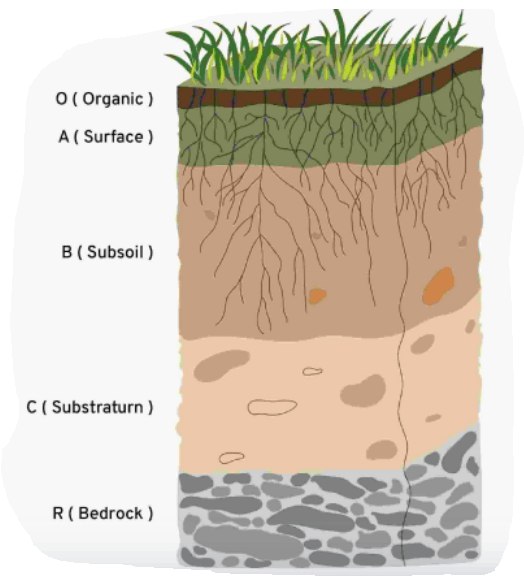
7. Sketch the cross-section of soil and label the various layers.
Ans: The cross-section of soil is shown below.
8. Razia conducted an experiment in the field related to the rate of percolation. She observed that it took 40 min. for 200mL of water to percolate through the soil sample. Calculate the rate of percolation.
Ans: Rate of percolation= amount of waterpercolation time amount of waterpercolation time
Rate of percolation = 200mL400min200��400���
Rate of percolation = 5mL/min5��/���
9. Explain how soil pollution and soil erosion could be prevented.
Ans: Soil pollution is the contamination of the soil caused mainly by the waste materials discarded by humans and other human activities.
The soil pollution and soil erosion could be prevented by
- By stopping cutting trees.
- By starting to grow more and more trees.
- By controlling and reducing the use of plastics.
- By treating the industrial waste before letting it out in the soil.
- Overgrazing of grassland should be avoided.
10. Solve the following crossword puzzle with the clues given:
1. Across
2. Plantation prevents it.
3. Use should be banned to avoid soil pollution.
4. Type of soil used for making pottery.
5. Living organisms in the soil.
Down
1. In desert soil erosion occurs through.
3. Clay and loam are suitable for cereals.
4. This type of soil can hold very little water.
5. Collective name for layers of soil.
| 1. W | ||||||||||||
| 2. E | ||||||||||||
| 3.W | ||||||||||||
| 4. S | 5. P | |||||||||||
| 6. C | ||||||||||||
| 7.E |
Ans:
| 1. W | ||||||||||||
| I | 2. E | R | O | S | I | O | N | |||||
| N | 3.W | |||||||||||
| D | H | |||||||||||
| 4. S | 5. P | O | L | Y | T | H | E | N | E | |||
| A | R | A | ||||||||||
| N | O | T | ||||||||||
| D | F | 6. C | L | A | Y | |||||||
| Y | I | |||||||||||
| L | ||||||||||||
| 7.E | A | R | T | H | W | O | R | M |
NCERT Solutions for Class 7 Science – Free PDF Download
NCERT Solutions for Class 7 Science Chapter 9 soil helps students greatly. The answers provided by Study Studio experts in NCERT class 7 science chapter 9 soil pdf are well connected to the topics of NCERT class 7 Chapter 9 Science. Additionally, NCERT solution for class 7 science chapter 9 is explained in an easy, descriptive, and simple manner that is helpful for all students to get the basic idea of the chapter.
Chapter 9 – Soil
NCERT Solutions for Class 7 Science Chapters
9.1 Soil Teeming with Life
Soil comprises numerous species and they form a complex and dynamic ecosystem. It is one of the highly precious natural resources. Plants and animals help keep the soil fertile. The roots of the plants go inside the soil and bind it up. Burrowing animals mix the soil and the excreta of animals provide nutrients that improve the structure of the soil.
Besides the apparent inhabitants of soil that comprise rodents, slugs, snails, mites, insects, earthworms, and spiders, there are present numerous microscopic residents and some of them are helpful to humans while some are harmful.
Plastics and polythene bags end up polluting the soil. They are also responsible for killing the organisms that live in the soil. So, we are asked to ban plastics and polythene bags. Some other compounds that contaminate the soil are chemicals, pesticides, and waste products.
9.2 Soil Profile
There are different layers of soil. You can perform a simple activity to discover the arrangement of these layers. The presence of rotting dead matter is known as humus. When the rocks break down through the actions of water, and wind, then the soil is formed. This process is known as weathering.
The vertical sections of various soil layers are known as soil profile and every layer is different from one another in depth, colour, chemical composition, and texture. These layers are known as horizons.
Commonly, the uppermost horizon remains dark in colour because of the presence of minerals and humus. The humus remains responsible for the fertility of the soil and it provides nutrients to the growing plants. Generally, this layer is porous and can preserve more water.
This is known as the topsoil and provides shelter to many living organisms, like rodents, beetles, moles, and worms. The topsoil also holds the roots of smaller plants. The subsequent layer of soil possesses more nutrients and lesser humus and this layer is more compact and harder. This layer is called the middle layer or B-horizon. The third layer is known as C-horizon and it comprises little lumps of rocks having crevices and cracks. The layer which is below the C-horizon is known as the bedrock and it is hard and so, you can’t dig this soil with a spade.
9.3 Soil Types
Perhaps you know that the weathering of rocks is responsible for producing little parts of different materials. They comprise clay and sand. The amounts of clay and sand are dependent on the rock from which these particles are formed and this is known as the parent rock. The combination of humus and rock particles is known as the soil. Some living organisms, like plant roots, earthworms, and bacteria are vital portions of any soil. You can classify soil by the presence of particles of various sizes. When the soil comprises more amounts of bigger particles, then the soil is known as sandy soil.
Now, when the percentage of fine particles that is present in the soil is comparatively higher, then it is known as clayey soil. Now, if the proportion of fine and large particles remains the same, then this soil is known as loamy soil. Therefore, you can classify soil as sandy, clayey, and loamy.
The particles present in the soil have a huge effect on the properties of the soil. Sand particles tend to be large and as they can’t fit together closely so, you will see huge spaces between them. These spaces remain filled with air. Water can quickly drain through these spaces and so sandy soil is well-aerated, dry, and light.
As clay particles are smaller, they pack together tightly leaving very little room for air to go inside the spaces. Water is held in the small gaps between clay particles and this is the reason for clay soils to have very little air. However, they are heavy because they can hold more water compared to sandy soils. The finest topsoil to grow plants is loam and this soil is a combination of clay, sand, and another kind of soil particle called silt.
9.4 Properties of Soil
Soil Texture
Soil comprises particles of various sizes and the texture of the soil can be observed by the size of the components that build up the soil. It is dependent on the quantity of silt, clay-size, and sand particles besides the organic matters present in the soil. When you rub sandy soil in your hands you feel gritty between your fingers. Silt feels smooth and the majority of the clays happen to be moldable and sticky.
Structure of the Soil
The structure of the soil explains the method in which clay particles, silt, and sand get clumped together. Soil organisms, such as bacteria and earthworms along with organic matter, like decaying animals and plants influence the structure of the soil. Organic matter, and clays that the soil organisms excrete bind the particles of the soil together for forming aggregates.
Soil Porosity
Soil porosity is referred to as the pores present within the soil and it affects the movement of water and air. Poor quality soils have visible cracks, holes, and pores and healthy soils have numerous pores within the aggregates.
Soil Colour
The colours of soil range from red to white to black. At times, the soil is blue too. Commonly, the colour of the soil emerges from iron and organic matters. Most often, the topsoil is dark in colour due to the presence of organic matter. When soil is of a single colour, then it symbolizes that it is well-drained. Contrarily, grey patches and rusty spots symbolize poor drainage.
9.5 Moisture in Soil
The amount of water that is held in soil happens to be a vital element of ecological and biological processes. This is useful in applications, like prevention of erosion, farming, drought prediction, and flood control. Commonly, soil comprises a definite amount of water which is known as the moisture content of the soil. When the pore space of the soil gets occupied by air then the soil becomes completely dry. When the pores remain filled with water, the soil becomes saturated.
9.6 Absorption of Water by Soil
Clayey soils possess colloidal components that can hold water but they are poor in aeration. Again, rock particles of huge sizes don’t hold water between them. Any soil that comprises rock particles and doesn’t hold water between them isn’t suited for the growth of the root system of plants. Loamy soil provides excellent aeration, as well as ideal capillary spaces for holding water and it has the combination of sand, decomposed organic material, and clay known as humus. So, this kind of soil is ideal for the development of plants as it possesses a good water-retention capacity.
9.7 Soil and Crops
You will find different kinds of soils in different corners of India. At some places, the soil is clayey and at some places, the soil is loamy. In some parts of India, you will find the soil to be sandy. Soil gets affected by rainfall, humidity, light, temperature, and wind. These are vital climatic factors that affect the soil profile. The component of the soil and the climatic factors determine different kinds of crops and vegetation that can be grown in a region. Loamy and clayey soils are ideal to grow cereals, such as gram and wheat. These soils can retain water very well.
For growing paddy, you need soils that are rich in organic matter and clay. Lentils and other pulses require loamy soils that can drain water. Cotton needs loamy or sandy-loam soil that can drain water easily. Some crops, like wheat, are grown in the clayey soils as they are very fertile and rich in humus.
Soil Erosion
When the land surface is removed by wind, ice, or water, then it is called erosion. The roots of the plants bind the soil firmly and when there is no plant, the soil becomes loose. So, it gets moved by flowing water and wind. Soil erosion is more severe in places with no surface vegetation, like bare lands or deserts. Hence, we should always discourage deforestation and cutting of trees, to save our soil resources.
Exercise 9.7 total Solutions: 13 Questions (10 short questions and 3 long questions).
Key Features of NCERT Solutions for Class 7 Science Chapter 9
The key features of NCERT Solutions for Class 7 Science is provided by Study experts for helping students so that they can answer the questions correctly. The benefits of these solutions are given below.
- Every solution to soil Chapter Class 7 is presented in a logical methodology and approach.
- Students can get ample materials for NCERT Class 7 Science Chapter 9 soil that will be helpful to form an excellent base.
- The solutions of NCERT for Class 7th Science Chapter 9 provide an updated and comprehensive coverage of all the topics in this chapter.
- The CBSE Class 7 Science Chapter 9 soil is specially written to help students to secure good grades in the exams.
- Every topic of NCERT Class 7 Science Ch 9 aims to provide an in-depth understanding of the concepts of soil and its component layers.
Conclusion
The NCERT Solutions for Class 7 Science Chapter 9 – Soil, provided by Study Studio, is a valuable tool for Class 7 students. It helps introduce Science concepts in an accessible manner. The provided solutions and explanations simplify complex ideas, making it easier for Class 7 Students to understand the material. By using Study Studio’s resources, Students can develop a deeper understanding of NCERT concepts. These solutions are a helpful aid for Class 7 students, empowering them to excel in their studies and develop a genuine appreciation for the Soil chapter.