Study Studio’s NCERT Solutions for Class 6 Science Social and Political Life, are the most effective resources for your examination preparations. The NCERT Class 6 Social Science solutions can assist you with a good deal as it involves understanding the topic more easily. These solutions are prepared by professional and experienced teachers at Study Studio. At Study Studio, you will find answers to all your questions from Class 6 Social Science Chapter 8. Our subject experts curate answers that are easy to understand and give the best possible solutions to NCERT questions class 6 sst chapter 8.
Access NCERT Solutions for Class 6 Social Science Chapter 8 – Rural Livelihoods
Q1. You have probably noticed that people in Kalpattu are engaged in a variety of non-farm work. List five of these.
Ans: Some of the non-farm work done by the people in Kalpattu were:
a. Trading
b. Making baskets and utensils
c. Blacksmith
d. Shop keeping
e. Teaching
Q2. List the different types of people you read about in Kalpattu who depend on farming. Who is the poorest among them and why?
Ans: Three categories of people were dependent on farming:
a. People who owed large area of land, i.e. the big land owners.
b. People who own a smaller are of land, i.e. the small land owners.
c. People who have no land, i.e. the landless people.
Landless farmers are the poorest individuals because they earn money during the harvesting season and then have to look for other jobs that pay them very little. Thulasi are the poorest people of Kalpattu.
Q3. Imagine you are a member of a fishing family and you are discussing whether to take a loan from the bank for an engine. What would you say?
Ans: If I came from a fishing family, I would have gotten a bank loan to buy an engine that would increase my earnings. I’d go with a bank for a loan since it’s a safe bet and it won’t charge me extra interest.
Q4. Poor rural labourers like Thulasi often do not have access to good medical facilities, good schools, and other resources. You have read about inequality in the first unit of this text. The difference between her and Ramalingam is one of inequality. Do you think this is a fair situation? What do you think can be done? Discuss in class.
Ans: Our constitution states that everyone has equal access to resources. The disparity in access to amenities between her and Ramalingam contrasts this right of equality. Hence, it is the government’s responsibility to ensure that everyone has access to essential services and fare availability of loans.
Q5. What do you think the government can do to help farmers like Sekar when they get into debt? Discuss.
Ans: Government can help the farmers like Sekar in following ways:
a. By opening government Farming colleges.
b. By providing insurance for the cultivation.
c. By providing low-interest loans to them.
d. By providing fertilisers and insecticides at subsidized rates.
Q6. Compare the situation of Sekar and Ramalingam by filling out the following table:
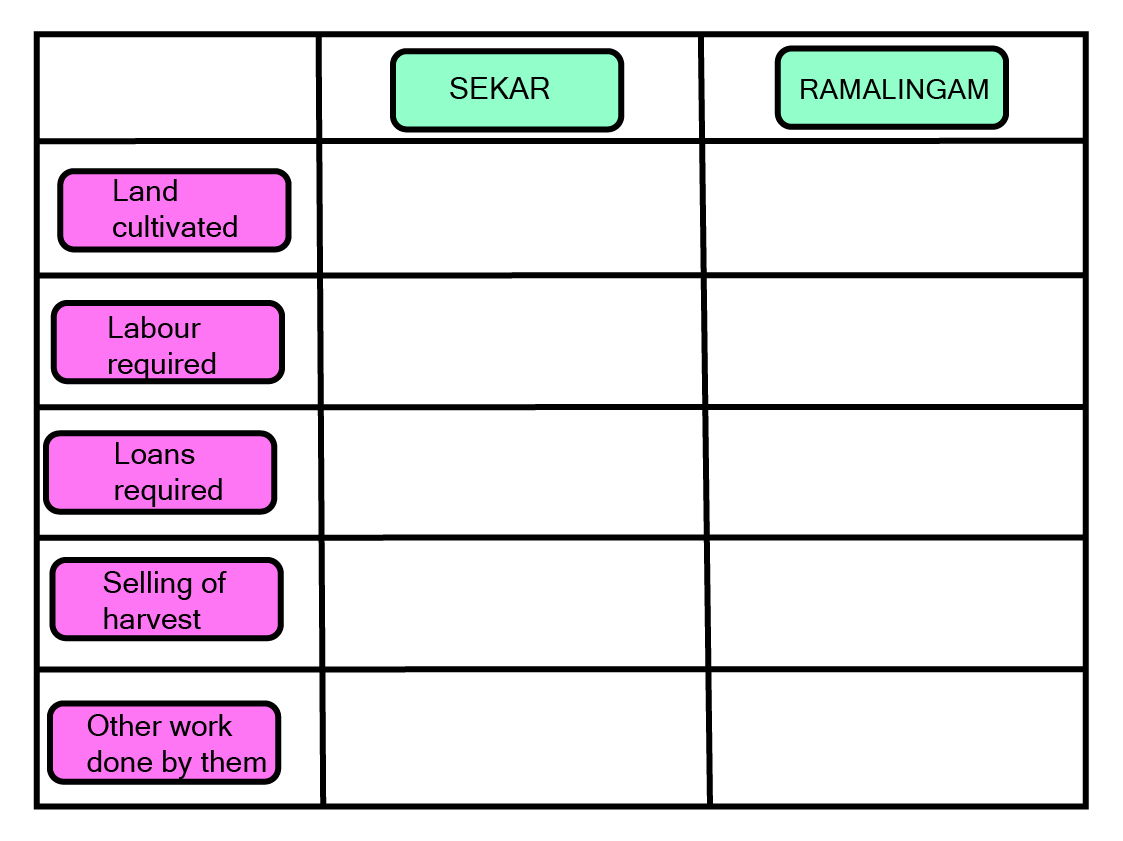
Ans: Following table distinguish between the situation of Sekar and Ramaligam:
| Sekar | Ramalingam | |
| Land cultivated | Sekar had 2 acres of land. | Ramalingam had 20 acres of land. |
| Labour cultivated | No labour required. | Large number of labour required. |
| Loans required | Loan is required for seeds and fertilizers. | Loan is required in order to put up the rice mills. |
| Selling of harvest | The harvest done by Sekar would be sold to the lenders at low price. | Harvest done at Ramaligam’s land would be sold at high cost to the traders. |
| Other work done by them | Work at Ramlingam’s rice mills as labourers. | Rice mills and a number of stores are owned by Ramalingam. |
While NCERT Solutions Class 6 Civics Chapter 8 are readily available on our website, it is also accessible for the students to download the NCERT Solutions Class 6 Social Science And Political Life Chapter 8 free. The free pdf once downloaded can be used to study offline as well. We at Study Studio ensure that studies do not get affected and interrupted.
NCERT Solutions Class 6 Social Science Offers Great Benefits
For Political Life Chapter 8 you will get numerous forms of study material in form of free pdf available on this website along with a variety of videos which can help you to have a better understanding of Chapter 8 Rural Livelihoods. In this chapter, there are various questions which talk about rural people and their living style. How they create employment for themselves and their survival. Also, the NCERT Class 6 Social and Political Life Chapter 8 talks about the following topics:
- Kalpattu village
- Thulasi
- Life of Sekhar
- Debt – the reasons behind it
- Agricultural labourers and farmers in India
Rural Livelihoods Class 6 Social Science Chapter 8
Rural areas don’t have trendy facilities and also the population is much less than in cities. In rural areas, half of the population is engaged in farming activities for their survival, others additionally involved in non-farming activities like creating butter, selling baskets, fishing, raising farm animals, and more. Chapter eight of CBSE Class 6 Social Science can facilitate students to grasp concerning Rural Livelihoods.
Different Occupations: Individuals in this village areas engaged in several professions like blacksmiths, teachers, washermen, weavers, barbers, mechanics, shopkeepers, and traders.
Shops: Kalpattu village encompasses a type of little retailers like tea-shops, grocery stores, barber retailers, artifact retailers, tailor retailers, fertilizers, and seed retailers.
Life of a Girl Farmer: The girl, Thulasi works in the farmland of Ramalingam and does numerous work like transplantation, paddy, weeding, and harvest. She earns forty rupees daily. She also does all household chores like washing utensils, cleansing house, and laundry garments.
Being in Debt: Farmers borrow cash to fulfill the essential desires of the farming land. Sometimes, they’re unable to get back the loan because of the failure of monsoon, which ends in debt and at last the key reason behind distress.
Farmers: In Kalpattu village, the people are involved in various farming and non-farming work like Making baskets, utensils, pots, bricks bullock-carts, etc. Also, Teaching, Washing clothes, Weaving, and Repairing cycles are some of the work they do as employment sources. Huge farmers cultivate their land and sell their merchandise within the market. Some individuals within the village depend on the forest, agriculture, farm manufacture, fishing, etc.
Sources of Livelihood: Farming and assortment of Mahua, tendu leaves, honey, etc. from the forest square measure the vital sources of the keep.
Rural Livelihood: Individuals in rural areas earn their living in numerous ways. They undertake farming or non¬farming activities. However, some rural people keep moving from one place to another in search of work,if they are not satisfied .
Pudupet: Individuals earn their living by fishing within the ocean during this space. Catamarans (fishing boats) are used for fishing. They come back to the coast with their catch to sell within the market. Fishermen typically take loans from banks to get catamarans, nets, and engines.
Some of the Other Ways During Which Individuals Earn their Living in Villages are Discussed Below
- Village individuals are engaged in farm activity and non-farm works, like creating utensils, baskets, etc.
- Working on farms involves operations like making ready the land, sowing, weeding, and harvest of crops.
- In India, nearly 2 out of each 5 rural families are manual laborer families.
- The members of those families typically work in different people’s fields to earn a living.
- In India, eighty percent of farmers belong to the current cluster. Solely twenty percent of India’s farmers square measure well-off.
- Many people in rural areas depend on an assortment from the forest, agriculture, farm manufacture, fishing, etc.
Some Important Terms
Rural Livelihoods: Other ways of earning living in rural areas.
Pesticide: A chemical used for killing pests, particularly insects.
Migration: The movement of an oversized variety of individuals from one place to another to search out jobs.
Harvest: The act of cutting and gathering crops.
Terrace Farming: This can be a kind of farming during which the land on a hill slope is formed into flat plots and carvings come in steps. The edges of every plot square measure raised to retain water. This permits water to stand within the field, which is appropriate for rice cultivation.